
Baby Hermes' Day Out
The messenger god with a taste for beef and naughtiness

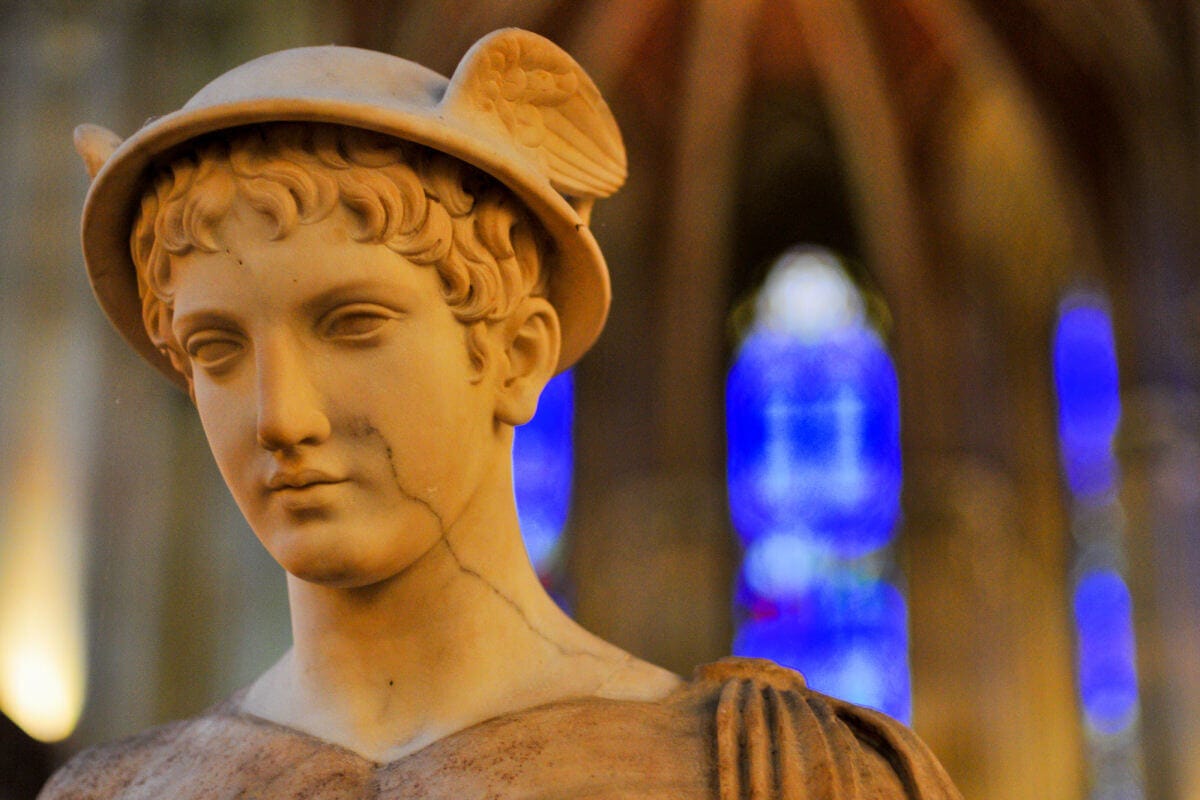
I chose to start the Classics Tutor newsletter with a brief description of one of the Homeric Hymns. Although these hymns were likely not written by one man named Homer, nonetheless, he seems like a good place to begin our adventure in classics.
There are certainly older topics which fascinate me from archaic lands of Greece, Italy, Sicily, Anatolia, and the Black Sea, but for now let’s take a moment to explore the god of cunning and thievery, messenger of Zeus to Hades, bringer of dreams, commerce, communications, night guardian, and psychopomp (one who leads the souls of the dead into the underworld).
Let’s face it, Hermes has a lot on his plate.
In Homer’s Hymn to Hermes, we see the quick development of a god born in humble circumstances. His mother, Maia, was a minor deity, or nymph, who gave birth to Zeus’ little godling in a cave on Mount Kyllene, on the Peloponnese of Greece.
Homer chose to invoke Hermes by using the epithet “polytropos”, meaning “of many shifts”. Shifty. Smooth operator. We will note here and in many other primary sources from the classical world, that being tricky is a good thing.
After exiting Maia’s womb, Hermes proceeds to raise hell. First, he meets a tortoise outside the cave. He strangely decides to call the tortoise a "shapely charmer," and he then proceeds to kill her and make a lyre out of her. Pretty naughty.
Baby Hermes then gets a hankering for meat, so he decides to go to Pieria, where Apollo’s sacred cattle are stabled. He absconds with no fewer than 50 cows, driving them backward, so they will be difficult to track down. He then makes a pair of huge slipper-like sandals for himself to make his footprints unrecognizable. Shifty.
Interestingly, Hermes butchers the cattle and sets aside a portion of the meat for each of the Olympian gods. Good thinking. Still, Apollo is less than pleased. He tracks the baby down and confronts him about the cattle. A quarrel ensues, and the matter is taken to their father, Zeus. After Apollo makes his case, Hermes protests without actually lying to Zeus. "I drove no cattle home," he says, and it is true. He did not take the cattle to their home but to his. He swears his innocence without stating what it is he's innocent of having done. Tricky.
Zeus bellows with laughter because he is impressed with this young upstart son of his. The ruler of the cosmos was amused. Whew. Apollo agrees to a truce, and the two brothers head out to the place where the cattle were hidden. Hermes entertains Apollo by strumming his tortoise-shell lyre. He plays the lyre and sings to Apollo, who is pleased. Hermes then gives the lyre to him, and, in turn, Apollo gives Hermes the whip used to drive his cattle, officially making Hermes a sacred cattle herder.
Needless to say, Zeus was gladdened that the brothers made peace and delights in their happy return to Mount Olympus. Then Apollo asks Hermes to swear by the gods that he won't steal the lyre back, and so Hermes makes a new musical instrument for himself by stringing reeds to form a panpipe. The hymn closes with Apollo naming Hermes's honors, including being the "appointed messenger" to Hades, god of the underworld. Forever after, it would be Hermes who leads the dead to their final home.
This an interesting story, and certainly one of the longest of the known Homeric Hymns. Hermes is clearly an ingenious, quick, and talented young deity, but he also has a frightfully chilling side to his personality. I am thinking here of the poor little tortoise. This, I believe, was a poetic way of having us hold respect and awe for the little god. Just because he was born in a cave and used a winnowing fan as a bed, the poet seems to be saying, “Look out for this one.”
Until next time, keep being shifty!
Donald Donato, The Classics Tutor