
Bona Dea
Guarantor of Virtue, Fertility & The Health of the Roman People

The Roman goddess Bona Dea (“The Good Goddess”) was an ancient deity whose true name was a closely guarded secret known only to her female initiates. Her worship was particularly secretive and exclusively reserved for women, making her one of the more mysterious figures in the Roman pantheon. She was generally associated with fertility, healing, virginity, and the protection of the Roman people. Many scholars identify her as an aspect of the earth goddess Fauna, the daughter and wife of the rustic god Faunus. Faunus was said to have beaten her with a myrtle rod for drinking wine, an act forbidden to Roman women, yet wine (or milk substituted for wine) was a key component of her later rites, suggesting a complex relationship between her original prohibition and the ritual’s purpose.1 Most scholars agree that the strict prohibition against women drinking wine essentially faded away and was replaced by custom, moderation, and social acceptance by the time of the Late Roman Republic and the start of the Roman Empire, roughly the 1st century BCE to 1st century CE.
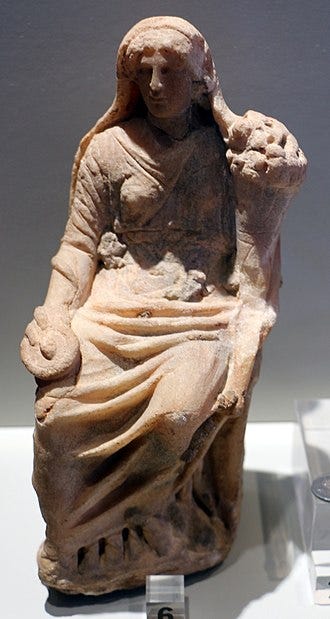
The origin of Bona Dea is shrouded in myth and antiquity. One popular story, recounted by Macrobius in his Saturnalia, states that she was the daughter of Faunus, and after she rejected his sexual advances, he beat her to death with a myrtle staff (3.12.7-10). Jupiter, pitying her, deified her, and her cult became marked by the exclusion of men and the prohibition of the myrtle tree. This myth ties her to the sanctity of female chastity and domestic virtue. Historically, her worship was centered in two main locations: a temple on the Aventine Hill, dedicated in 272 BCE, and a lesser shrine in a grove outside the city. The Aventine Temple, where supplicants would often leave behind medicines and herbal remedies, highlights her strong connection to healing. This is further attested by numerous ex-voto offerings of snakes found at her shrines, as the snake was a symbol of rejuvenation and healing associated with Asclepius and other chthonic deities.
Bona Dea was honored with two principal festivals during the Roman year. The first, a public annual festival, was celebrated on May 1st at her temple on the Aventine Hill. The more significant and widely discussed festival, however, was the secret nocturnal rite held on the night of December 3rd or 4th.2 This ritual was conducted annually by the wife of the consul or a high magistrate, known as the mater familias, and was attended only by Roman matrons and Vestal Virgins. The ceremony took place in the domus publica, or official residence, of the magistrate, while the male inhabitants, including the magistrate himself, were required to be absent.
Our most vivid and detailed primary sources regarding this December feast do not focus on the religious tenets, but on a sensational political scandal: the desecration of the rites by Publius Clodius Pulcher in 62 BCE. Cicero and Plutarch provide extensive, albeit politically biased, accounts of this event. Cicero, in his letters and speeches, uses the incident to condemn Clodius, describing how he allegedly dressed as a woman to sneak into the house of Gaius Julius Caesar, whose wife, Pompeia, was presiding over the rites that year.3 Plutarch corroborates the story in his Life of Caesar and Life of Cicero, noting that the secrecy of the rites, where no man might look upon them, made Clodius’s sacrilege particularly egregious.4 These accounts confirm that the rituals involved sacrifices, the use of wine and milk, and decorations featuring a vine—all symbolic of the goddess’s chthonic and fertile nature—while forbidding the naming of the goddess or the presence of the myrtle tree or any image of a male.5 Juvenal also later satirized the secrecy and license of the women attending the festival, though his account is likely exaggerated for comedic effect.6
The worship of Bona Dea was strongly connected with healing and the restoration of health. The goddess was petitioned by her devotees for divine aid, and success was often attributed to her power. The historian Valerius Maximus records an instance of divine intervention related to her sanctity. He tells the story of an attendant named Felix Asinianus who, having been abandoned by doctors for a severe eye ailment, regained his sight through the power of the goddess, providing a clear example of a miraculous cure credited to her.7 Furthermore, the care of the snake, a creature associated with healing in the Greco-Roman world, was a vital part of her cult. Macrobius, when discussing the cult of Bona Dea, confirms that snakes were considered sacred to her and were kept in her temple, underscoring her role as a benevolent healer.8
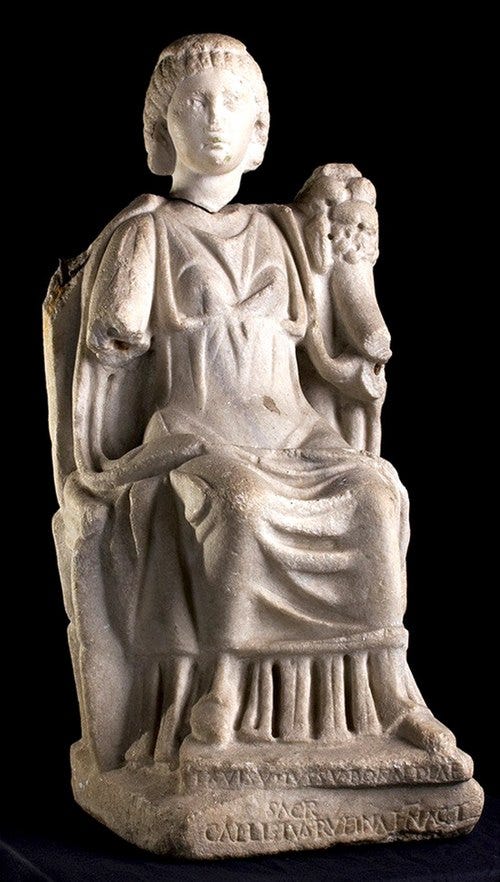
Bona Dea was intimately linked to the natural world, particularly through her identification with the rustic deities Faunus and Fauna. Her worship sites often took the form of or included sacred groves. Propertius, in his poetry, recounts an episode where the hero Hercules bursts into her Sacred Grove (lucus), an act that violated the sanctity of the place. Propertius notes that the location of her rituals was a “grove” that “encloses the site of the sacred ceremony,” emphasizing that this natural, enclosed space was fundamental to the cult.9 This connection to the grove as a secluded and sanctified space is further supported by the testimony of Plutarch, who describes the exclusive nocturnal ritual held in honor of the goddess as one into which no male might look, highlighting the isolation and secrecy of the sacred location.10
The importance and mysteries surrounding Bona Dea derive fundamentally from her unique role as a state-sponsored but exclusively female deity within Roman religion. Her importance to the state was not as a warlike protectress or a legislative figure, but as the guarantor of female virtue, fertility, and the overall health and well-being (salus) of the Roman people, a duty attested to by the cures credited to her.11 The solemnity of her public worship is confirmed by the annual December rite, which was presided over by the wives of the highest magistrates, such as Julius Caesar’s wife, Pompeia, and included the participation of the Vestal Virgins.12 This involvement of the female religious and social elite underscores her critical importance to the Roman social order, which relied on the perceived purity and fertility of its women.
The greatest source of mystery surrounding Bona Dea lies in the secrecy and exclusivity of her nocturnal rites. The core mystery involves her very name, which was forbidden to be uttered13, forcing Romans to refer to her only by the euphemism “The Good Goddess.” Further mysteries surround the ritual actions themselves, which were closed to all men, including the master of the house where the rite was conducted.14
The use of wine—a substance culturally forbidden to women in the earliest Roman era—under the guise of “milk” during the ceremony introduces a ritualistic paradox that hints at a complex, possibly chthonic, liberation or reversal of social constraints within the context of sacred time.15 This impenetrable veil of secrecy, which even invited satirical speculation from Roman authors like Juvenal, cemented her image as a powerful, ancient, and ultimately unknowable divine force operating at the very heart of the Roman domestic and spiritual life.16
________________________________
Bibliography and further reading
Beard, Mary, John North, and Simon Price. Religions of Rome: A History. Vol. 1. Cambridge University Press, 1998.
Cicero, Marcus Tullius. Letters to Atticus. Edited by D. R. Shackleton Bailey, Harvard University Press, 1999.
---. Pro Milone. Edited by T. E. Page, Macmillan and Co., 1891.
Juvenal. Satires. Edited by J. E. B. Mayor, Macmillan and Co., 1878.
Macrobius, Ambrosius Theodosius. Saturnalia. Edited by Robert A. Kaster, Harvard University Press, 2011.
Plutarch. Caesar. Plutarch’s Lives. Translated by Bernadotte Perrin, vol. 7, Harvard University Press, 1919.
---. Cicero. Plutarch’s Lives. Translated by Bernadotte Perrin, vol. 7, Harvard University Press, 1919.
Propertius, Sextus. Elegies. Edited by G. P. Goold, Harvard University Press, 1990.
Valerius Maximus. Memorable Doings and Sayings. Edited by D. R. Shackleton Bailey, Harvard University Press, 2000.
Beard, North, and Price 165
Ibid. Beard, 165
Cicero, Letters to Atticus 1.13; Pro Milone 73
Plutarch, Caesar 9.3-10
Caesar 9.4
Juvenal, Satires 6.314-345
Valerius Maximus 1.8.6
Macrobius 3.12.7
Propertius 4.9.25, 30
Caesar 9.3-4
Valerius Maximus 1.8.6
Caesar 9.3
Macrobius 3.12.7
Caesar 9.3
Caesar 9.4
Juvenal 6.314-345