
Bound by Fate
The Twisted History of the Moirai

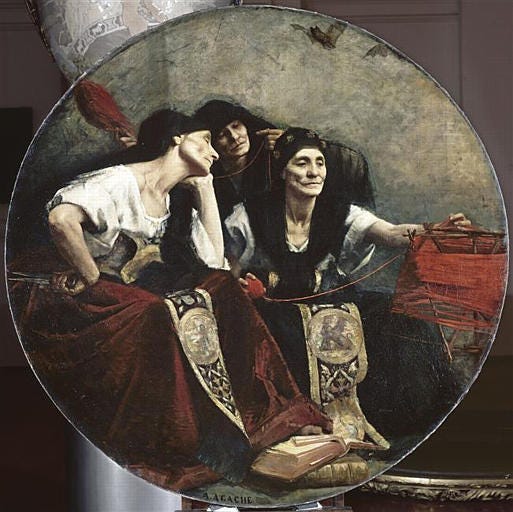
Fate is something that is ingrained in Western culture from our earliest stories. During the archaic period, there may have been only one personification of the Fates, called Moira, who is mentioned by Homer several times in his works. Only once did Homer write of the Moirai, plural, though during the classical period the myth of the three sisters became prevalent. These sisters were known to the Romans as the Parcae or Fatæ.[1] These goddesses were charged with making, measuring, and cutting the length and destiny of each human life. In Greek, they were known as Klotho (Clotho), the "the Spinner," spinning the thread of life, Lakhesis (Lachesis), "the Apportioner of Lots", who measured it, and Atropos (or Aisa), who cut the thread, marking everyone’s death. In Roman mythology, the three were known as Nona, Decuma, and Morta. In some texts and traditions, Zeus led the Moirai as Zeus Moiragetes (Leader of the Fates).[2]
There is some controversy and variation in the classical understanding of the origin and powers of the Fates and how they relate to the gods, especially when it comes to Zeus/Jupiter. The relationship between the gods and the Fates in Greco-Roman mythology is complex and surprisingly overlooked in many popular adaptations of Greek and Roman epics. Early literary evidence traces the Moirai back to being the daughters of Nyx[3], while still other sources (and sometimes the same source, such as Hesiod!) claim that they were born of Zeus and Thetis. Plato called the Fates the daughters of Ananke (compulsion)[4], and in the Fall of Troy (4th c. CE), they were referred to as the daughters of Chaos, the primordial void which predates all existence.[5] In some ways, this last attribution seems to make the most sense, but who are we to quibble with fate?
No matter which myths we examine, it is clear that the Moirai play a pivotal and central role. An example of their importance can be taken from Pindar (Fragment 30), in which the Fates join Zeus and Themis together in marriage, which in turn creates their daughters, the Horae (Horai), the goddesses of the seasons. Later, we see in Pausanias’ 2nd c. CE Description of Greece, a look at the arbitration of the Moirai:
Zeus learnt the whereabouts of Demeter when she had left to mourn Persephone leaving mankind to starve. Zeus learnt this from Pan, and sent the Moirai to Demeter, who listened to the Moirai and laid aside her wrath, moderating her grief as well.
Regardless of all the differing human attempts to describe their origins and powers, the fact remains that in Greco-Roman religion, the Fates held a very important position which was somewhat neutral to the many intrigues of the gods and mortals. The cult of their worship and its sanctuaries were to be found all over Greece, Asia Minor, and Magna Græcia.
The nature of the relationship between the Fates, the gods, and humans, becomes even more intriguing when we consider that great and powerful gods and deified heroes were unable to change the destiny of their favorite mortals. That is not to say there was not some flexibility in the way the Moirai functioned, especially with Zeus at the helm, but even the king of the gods and the master of the cosmos was beholden to the destiny they had woven.
Consider this passage by Aeschylus:
Chorus: Who then is the helmsman of Ananke (Necessity)?
Prometheus: The three-shaped Moirai and mindful Erinyes (Furies).
Chorus: Can it be that Zeus has less power than they do?
Prometheus: Yes, in that even he cannot escape what is foretold[6]
Through a preponderance of sources, it would appear that Zeus and other gods were to be bound to the determination of the Moirai. This universal law can be seen in extreme situations such as the death of Zeus’ beloved Semele, mother of the great god Dionysos, who was incinerated when he revealed himself to her in his true form, as she had requested[7].
Finally, as we read in Harpies and Fate in the Aeneid, Jove was bound to accept Aeneas’ destiny to eat pizzas before finding the fated grounds that would one day become the city of Rome.
An exploration of the Fates seems always to lead to pizza. Well, maybe not always…
***
[1] Fate | Greek and Roman mythology | Britannica".
[2] Hesiod, Theogony 901
[3] Hesiod, Theogony 211
[4] Plato, Republic 617c
[5] Quintus Smyrnaeus, Fall of Troy 3. 755
[6] Aeschylus, Prometheus Bound 515
[7] Nonnos, Dionysiaca 8. 351
My takeaway here is that in recently journeying to Naples for the first time, where I ate a great deal of pizza, I was merely following the path laid out for me by Fate. 😃