

Deep Waters and Dark Fears
The Symbolic Geography of the Underworld from Homer to Dante

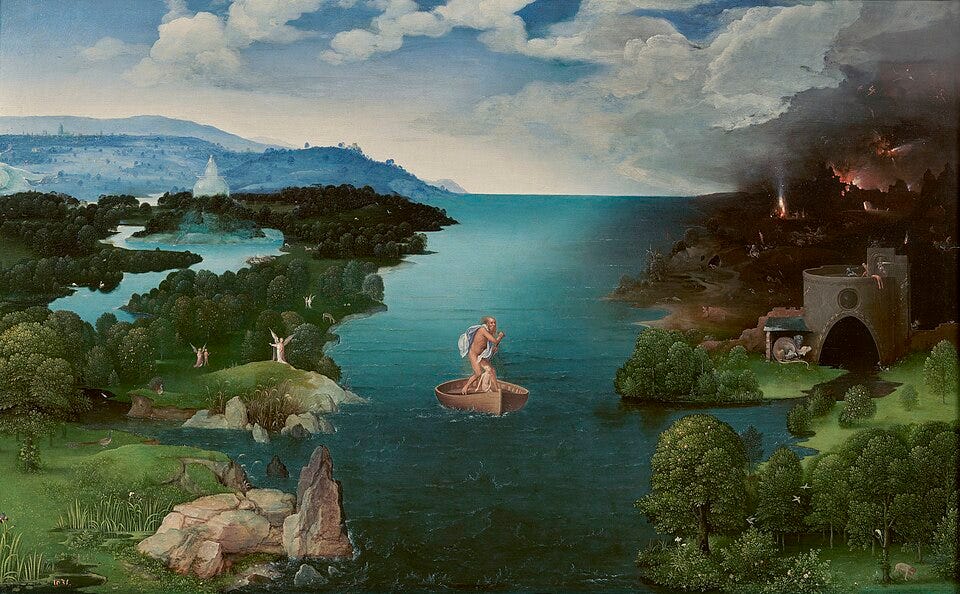
The subaqueous geography of the classical Underworld is not merely a collection of physical barriers separating the living from the dead, but a map of the ancient psyche grappling with memory, decay, and retribution. In the Graeco-Roman imagination, the transition from vitality to mortality was almost invariably mediated by water, an element that symbolized both the dissolution of identity and the heavy, stagnant weight of accumulated human error and miasma. Rather than an airy void, the chthonic realm was envisioned as a subterranean wetland—a place of dark fens, sluggish rivers, and choked bogs where the souls of the deceased were subjected to varying degrees of confinement and purgation. By examining these watery bodies, their symbolic resonance, and their subsequent reinvention in Dante Alighieri’s Inferno, one uncovers a profound philosophical tradition that views the afterlife not as a distant sky, but as a deep, reflective pool of moral consequence.
In primary classical texts, the Underworld is delineated by five primary rivers, each embodying a specific psychological or emotional state associated with death. The Acheron, often translated as the river of woe or misery, serves as the initial boundary of the infernal realm, where Charon ferries the newly departed across murky, turbulent waters (Virgil, Aeneid, 6.295-304). Closely linked to it is the Cocytus, the river of lamentation, which Homer describes as a branch of the Styx feeding into the Acheron with a shrill, mournful sound (Homer, Odyssey, 10.513-514). The Phlegethon, or Pyriphlegethon, introduces a more violent chthonic element, running not with water but with liquid fire, yet maintaining a fluid, river-like current that encircles the depths of Tartarus (Plato, Phaedo, 113b). In stark contrast to these tempestuous currents stands the Lethe, the river of forgetfulness, whose completely still, silent waters compel any soul that drinks from them to erase all memories of their earthly existence, a necessary prerequisite for reincarnation in some eschatological traditions (Plato, Republic, 10.621a).
Among these waterways, the Styx remains the most formidable and symbolically complex. It is described not merely as a river, but as a vast, hateful marsh or bog whose black waters wrap around the Underworld nine times (Virgil, Georgics, 4.479-480). The Styx represents the absolute finality of death and the inviolable cosmic order; even the Olympian gods swore their most binding, terrifying oaths by its waters, facing a decade of catatonic paralysis if they broke their word (Hesiod, Theogony, 775-806). The spooky, atmospheric qualities of these places—their perpetual gloom, the thick mists rising from sulfurous banks, and the hollow, echoing wails of disembodied shades—evoke a profound sense of claustrophobia. Water in the upper world represents life, movement, and purification, but in the underworld, it undergoes a sinister inversion. It becomes thick, stagnant, and heavy, symbolizing the trapping of the soul within its own unresolved mortal failings.
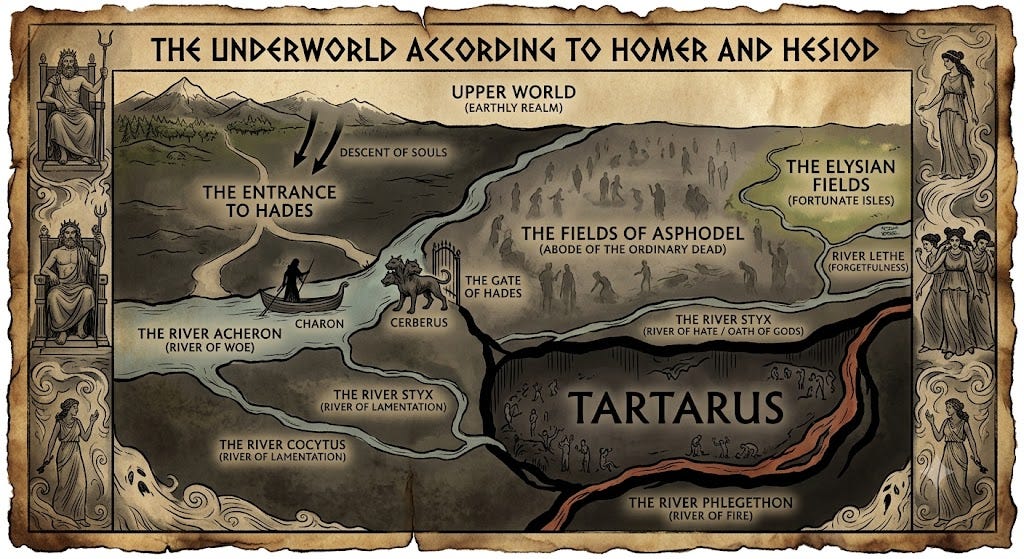
The condemnation of certain souls to a localized afterlife submerged within these underwater bogs reflects an ancient understanding of moral pollution. In the myth of Tartarus preserved by Plato, the underworld rivers act as a vast circulatory system for human wickedness, where souls are washed into subterranean lakes based on the severity of their crimes (Plato, Phaedo, 113d-114a). To be cast into a chthonic bog was to be denied the freedom of movement, anchored to the bottom of a murky abyss by the literal weight of one’s misdeeds. This concept is beautifully illustrated in classical depictions of the marshy banks of the Acheron and Styx, where those who lived aimless, uncommitted lives, or those consumed by sullen, suppressed anger, are bogged down in the mire, unable to lift their heads into the light of truth.
Centuries later, Dante Alighieri transformed this Graeco-Roman watery geography into a highly structured, theological framework of retribution in the Divine Comedy. In the Inferno, Dante retains the classical river system but links the bodies of water sequentially, transforming them into a singular, descending stream of sin that originates from the tears of the Old Man of Crete (Dante, Inferno, 14.94-119). Across the Acheron, Dante encounters the neutrals and the unbaptized, but it is in the Fifth Circle, at the Stygian marsh, where the classical bog receives its most vivid psychological elaboration. Dante depicts the Styx as a vast, muddy swamp wherein the wrathful violently tear each other apart on the surface, while beneath the slime, the sullen are completely submerged, their presence indicated only by the bubbles rising to the top as they gurgle a choked confession of their lifelong gloom (Dante, Inferno, 7.100-126).
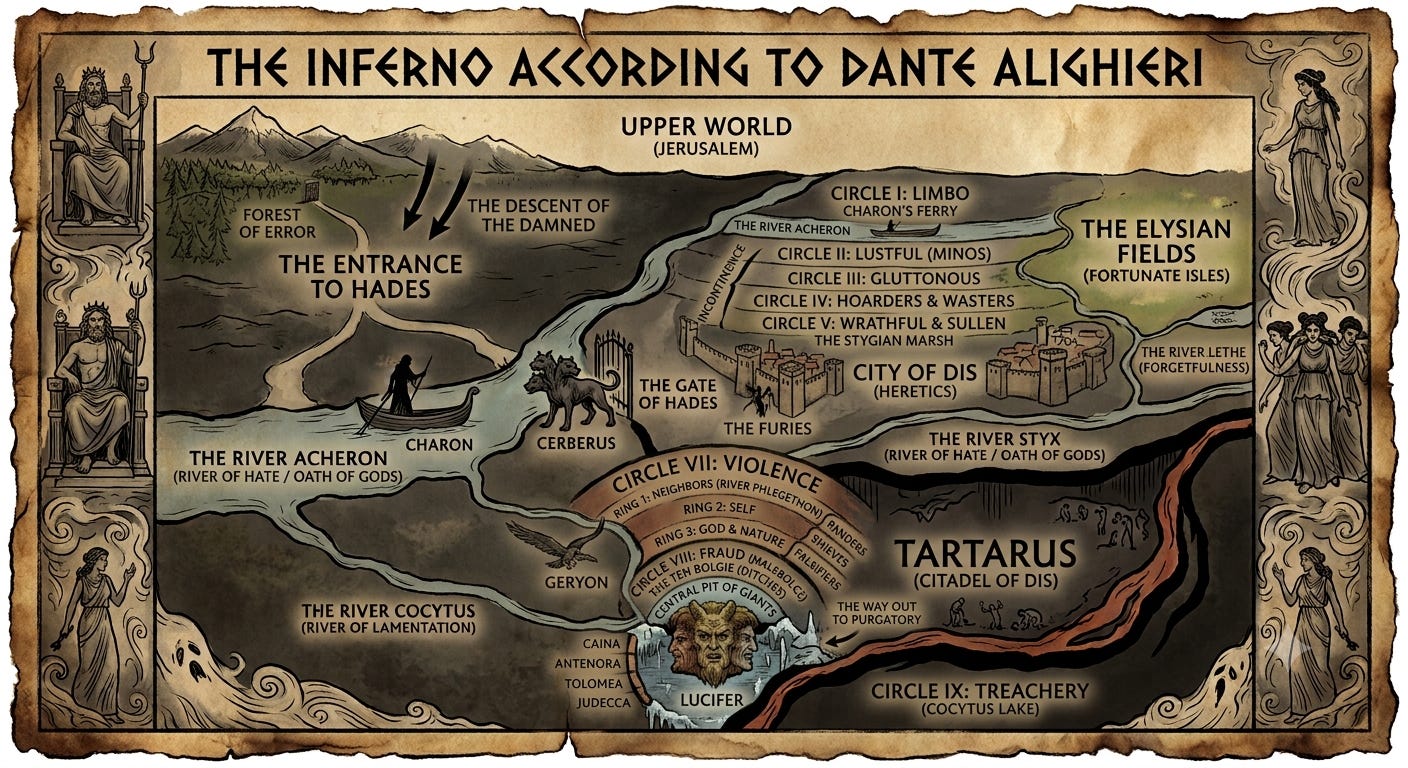
Dante further adapts the fiery Phlegethon into a river of boiling blood, where perpetrators of violence against their neighbors are immersed at depths corresponding to the gravity of their slaughter (Dante, Inferno, 12.46-54). The Cocytus undergoes the most radical transformation of all; rather than a flowing river of tears, it becomes a vast, frozen lake at the very bottom of hell, kept solid by the icy wind generated by Lucifer’s beating wings (Dante, Inferno, 32.22-30). Here, the water imagery reaches its ultimate symbolic conclusion. Water, which began as a turbulent river of emotion and woe in the upper circles, is entirely petrified into ice at the core of the earth. This freezing signifies the total absence of divine warmth, love, and mobility, condemning traitors to eternal isolation within a crystalline prison of their own cold-hearted calculations.
The underlying symbolism of water and death within these combined classical and medieval contexts reveals a dual nature. Water is the ultimate solvent, capable of erasing identity, as seen in the Lethe, or dissolving the pride of the ego, as seen in the penitential crossings of the Acheron. Yet, when corrupted by human vice, it transforms into a suffocating, dense medium that mirrors the spiritual state of the damned. The transition from life to death is an entry into the fluid unconscious, where the unpurified soul risks drowning in the accumulated debris of its past choices. Whether it is the ancient Greek dread of the dark, stagnant Styx or Dante’s terrifying vision of a frozen Cocytus, the underworld waters remind humanity that moral failures clog the spiritual passages of the universe, turning the cradle of life into an inescapable, subaqueous tomb.
Bibliography
Dante Alighieri. (1996). The Divine Comedy: Inferno. (R. Durling, Trans.). Oxford University Press.
Hesiod. (2006). Theogony and Works and Days. (M. L. West, Trans.). Oxford University Press.
Homer. (1995). The Odyssey. (A. T. Murray, Trans., Revised by G. E. Dimock). Harvard University Press.
Plato. (1997). Plato: Complete Works. (J. M. Cooper, Ed.). Hackett Publishing Company.
Virgil. (2007). The Aeneid. (R. Fagles, Trans.). Viking Penguin.
Virgil. (2005). Virgil’s Georgics. (J. Lembke, Trans.). Yale University Press.