
Greco-Roman Jewelry
The Story of Bling from Prometheus to Pliny

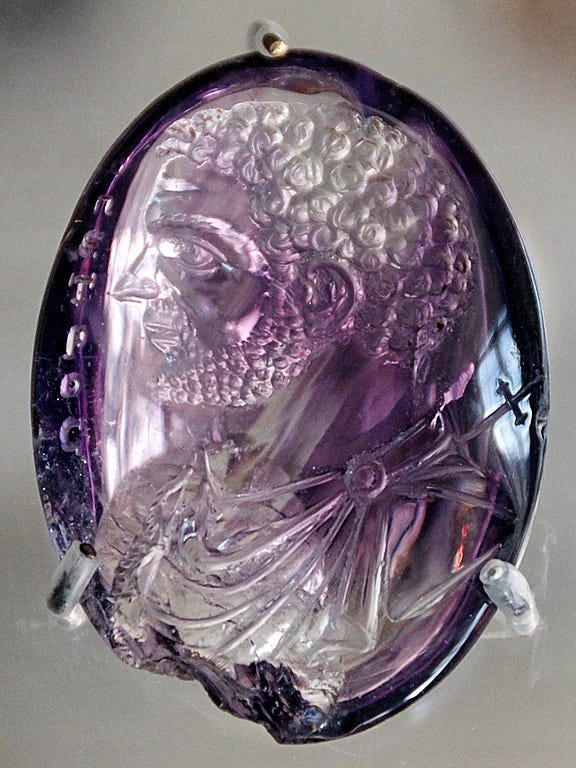
It was Gaius Plinius Secundus (23/24 CE – 79 CE), better known as Pliny, who wrote that the custom of wearing precious stones came from the Caucasus Mountains, where the Titan Prometheus had been bound as punishment by Zeus for giving humanity the knowledge to make fire.
Pliny wrote:
“We have already stated, to some extent, when speaking on the subject of gold and rings, how the use of precious stones first originated, and from what beginnings this admiration of them has now increased to such a universal passion. According to fabulous lore, the first use of them was suggested by the rocks of Caucasus, in consequence of an unhappy interpretation which was given to the story of the chains of Prometheus: for we are told by tradition, that he enclosed a fragment of this stone in iron, and wore it upon his finger; such being the first ring and the first jewel known.”[1]
After Alexander the Great conquered Greece, Egypt, the Levant, Persia and parts of India, by 331 BCE, recent historians estimate that as much as 5.4 million kilograms of silver, gold and precious gems were flooded into the Greek empire.[2] When Pliny wrote his Natural History, he would have been at the tail end of this avalanche of gold and jewels, since he lived more than a couple of centuries after Alexander. But we can see in his History that gold and silver jewelry with precious and semi-precious stones had become all the rage in the Hellenistic world in which he lived.
One of the results of this huge influx of precious metals and gems was the exponential growth in the production of jewelry across the empire.[3] Between the time of Alexander and the rise of the Roman empire, the Hellenistic world, from Italy to Asia and Africa, had acquired a particularly strong taste for stones like amethyst and garnet.
Amethyst, coming from the ancient Greek word αμέθυστος: amethystos, meaning “not” and “intoxicate”. These gems, sacred to Dionysos, were believed by the Greeks and Romans to curb drunkenness. They were therefore used to make chalices for wine drinking, as well as stones to be worn, and beautifully fiery intaglios such as the one depicted above.[4]
Pliny wrote of this gem,
“[W]hile to many they are known as ‘Venus’ eyelid,’ a name which would seem to be particularly appropriate to the colour and general appearance of the gem. The falsehoods of the magicians would persuade us that these stones are preventive of inebriety, and that it is from this that they have derived their name. They tell us also, that if we inscribe the names of the sun and moon upon this stone, and then wear it suspended from the neck, with some hair of the cynocephalus and feathers of the swallow, it will act as a preservative against all noxious spells. It is said too, that worn in any manner, this stone will ensure access to the presence of kings; and that it will avert hail and the attacks of locusts, if a certain prayer is also repeated which they mention.”[5]
I’ll bet you had no idea amethyst was so incredibly useful!
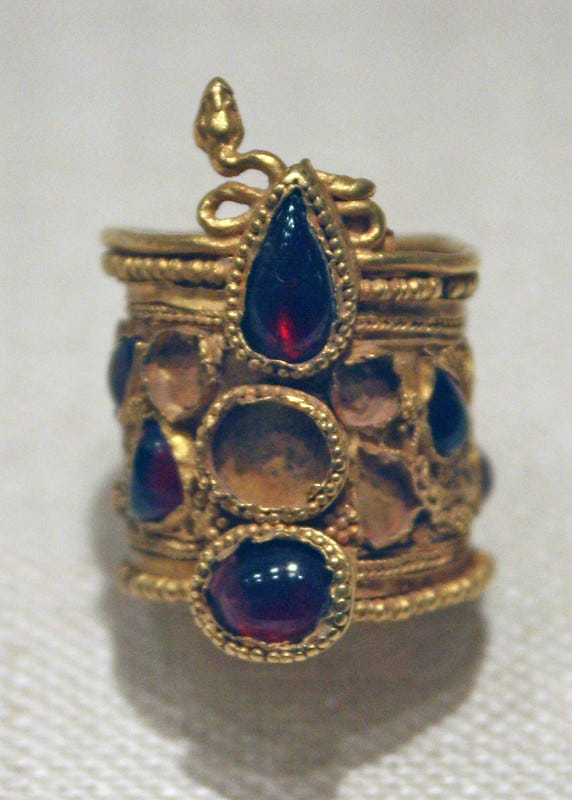
Garnets were principally used to make seals, but they were also crafted into personal rings and other costume jewelry of the time, usually set in gold. In addition to decorative pieces, garnets were also crushed and used as an abrasive. They were associated with the pomegranate, and therefore with the cult of Persephone.
According to Pliny, gemstones were ranked according to several criteria, including aesthetics, rarity, and usefulness. The following are a few examples taken from his book dedicated to the natural history of precious stones.
Adamas[6] “overcomes and neutralizes poisons, dispels delirium, and banishes groundless perturbations of the mind…”
Amber, “is good for any age, as a preventive of delirium and as a cure for strangury, either taken in drink or attached as an amulet to the body.”
Smaragdus (Emerald), “even when the vision has been fatigued with intently viewing other objects, it is refreshed by being turned upon this stone; and lapidaries know of nothing that is more gratefully soothing to the eyes, its soft green tints being wonderfully adapted for assuaging lassitude, when felt in those organs.”
Sardonyx “in our part of the world they were formerly valued from the fact that they are nearly the only ones178 among the engraved precious stones that do not bring away the wax when an impression is made.”
Carbunculus[7], “these stones are to be found also at Orchomenus in Arcadia and in the Isle of Chios; the former of which are of a darker hue, and are used for making mirrors.”
Topaz, “is the largest of all the precious stones, and is the only one among those of high value that yields to the action of the file, the rest being polished by the aid of stone of Naxos.”
Daphnea (Laurel-stone), “is mentioned by Zoroaster as curative of epilepsy.”
Heliotrope, “is a stone of a blood-red colour, and we must not omit to mention the assurance given [by the magicians], that the possession of it reveals treacherous designs on the part of the barbarians. Zachalias of Babylon, in the books which he dedicated to King Mithridates, attributing the destinies of man to certain properties innate in precious stones, is not content with vaunting the merits of this stone as curative of diseases of the eyes and liver, but recommends it also as ensuring success to petitions addressed to kings. He also makes it play its part in lawsuits and judgments, and even goes so far as to say that it is highly beneficial to be rubbed with it on the field of battle.”
Gemstones had a wide variety of uses in ancient times, which may be why Pliny spent so much time detailing his Natural History with every imaginable stone, its origins, uses, and lore.
What we definitively learn from ancient commentators like Pliny is the fact that the human fascination with bling is certainly nothing new under the sun.
***
[1] Pliny. Natural History. 37
[2] Guy Rogers. “Frank L. Holt, The Treasures of Alexander the Great”, New England Classical Journal, Vol. 46, Issue 1, (2019), pp. 106-109
[3] See the Metropolitan Museum of Art’s exhibition, “Hellenistic Jewelry”.
[4] Rudler, Frederick William (1911). "Amethyst". In Chisholm, Hugh (ed.). Encyclopædia Britannica. Vol. 1 (11th ed.). Cambridge University Press. p. 852.
[5] Pliny, Natural History, 37.40
[6] This name was applied by the ancients to several minerals differing much in their physical properties. A few of these are quartz, specular iron ore, emery, and other substances of rather high degrees of hardness, which cannot now be identified. It is doubtful whether Pliny had any acquaintance with a real diamond."—System of Mineralogy, Art.
[7] Literally meaning a "red-hot coal." The carbunculus of Pliny is supposed to include not only the red, or Iron and Iron-lime garnet, but the Spinelle ruby also, or Oriental ruby.
It is a well known fact that stones bear healing powers, but this article, in which you provide ancient commentary on the subject, casts new light on the inherent value, and specific nature of the stones. The carving in amethyst is absolutely stunning. Thank you for sharing these beauties with us!