
Living Without Holy Books
Piety & Scripture in the Greco-Roman World

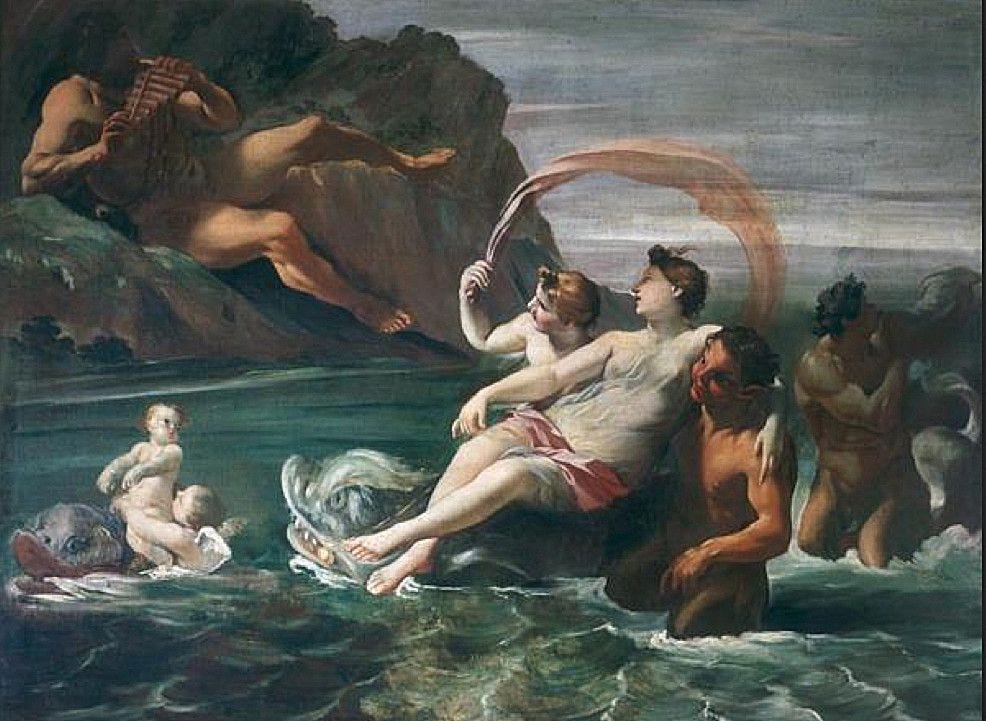
Imagine a world in which there are no holy books, no doctrinal battles, not even a sermon at your place of worship. For the millennia before the Abrahamic religions seized social and political control of the region, the pious people of the Mediterranean lived without scripture in their spiritual practices. They were happy to leave myths, literature, and plays, in the realm of historical fiction.
Perhaps by the time of the Roman empire, most households would have known some of the stories contained in The Iliad, The Odyssey, and The Aeneid. Still others would have been familiar with the myths of Hesiod, Herodotus and Ovid. But again, these writings were well understood to be things to be recited by the fire after dinner—not in a temple or sanctuary of the gods. The temple was a place of offerings and sacrifice, not sermons or readings. There was no credo, because to believe has nothing to do with ancient polytheism. Only actions maintained one’s relationship with the gods.
There is a very clear distinction between describing the actual nature of the divine and the legendary or physical patrimony of the gods. As Macrobius wrote:
“It is permissible for me to reveal the great origin of the Saturnalia—not the origin that touches on the secret nature of the divinity, but the one that is spoken of with an admixture of legendary elements or is revealed to all and sundry by the physical scientists. Telling the secret account that flows from the pure source of truth is forbidden even in the very midst of the rites, and if someone learns them, he is commanded to keep them hidden within his heart.”[1]
The core of the ancient cults of Greece and Rome are always held in secrecy, for these are the true mysteries. Whether we look at the Eleusinian Mysteries, which date back to the Mycenean period, more than a thousand years before the Common Era, or those of the Bacchic Mysteries, which are older still, initiates were strictly forbidden from uttering the secrets behind the Sacred Mysteries.[2] There were no holy scriptures, only the secret spoken words from the lips of the initiator into the ears of the initiated, and this only if one chose to be initiated.
This is the principle which must be properly understood when we speak of Greco-Roman religion—but let us look at what they meant by religion itself. The word religion comes from the Latin religio, roughly translated to mean “to re-bind.” It is not the primary word used, however, for what Romans would have considered their relationship with each other and the gods. Religion for them was superstitious, and based on ignorance and fear. Piety (pietas), was the aspect of Roman spiritual life which brought harmony to reign between the gods and humanity, as well as the rituals and laws which, if properly observed, could engender personal, spiritual development.[3]
One important aspect of understanding how the Romans viewed their religious practices is based on the oft-quoted principle dou ut des, “I give that you might give.” This shows us both reverence and reciprocity between mortals and immortals. However, the mere act of giving to the gods was not sufficient to somehow woo them. In fact, making sacrifices or offerings over and above the edicts of proper pietas, including traditions, rituals, laws, and the calendar, was seen as impious, and in many cases ended poorly.
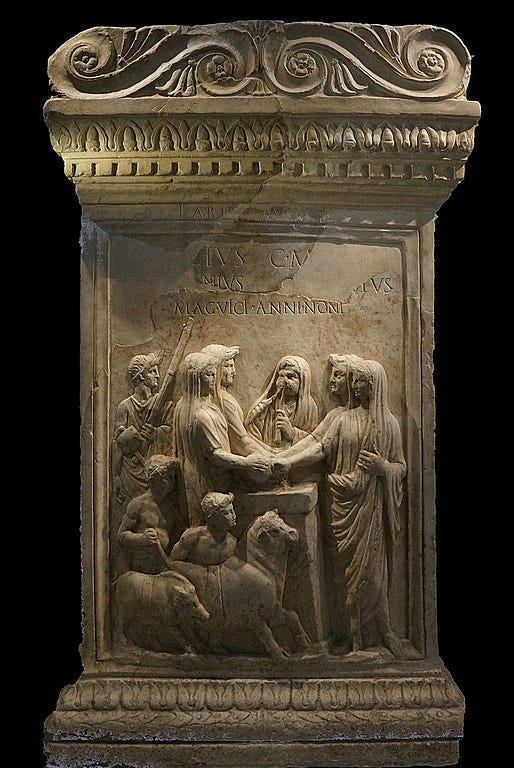
This brings us to the most misunderstood portion of specifically Roman spiritual practice, and that is the relationship between myth and ritual within the context of both an exoteric and esoteric take on the state religion of Rome. Myths may hold some keys to understanding the gods and our place in the cosmos, but they were never treated as scripture in the way today’s monotheistic religions do. Pietas was much more important to the Romans than myths. But by pietas, we must consider an entire way of life, not just a system of religious belief that can be separated from secular life. Pietas, in this sense, meant sharing one’s time equally with the gods in rituals, with family in domestic life, and with the community in civic life. It meant observing the feasts and fasting days, sacrifices, and games to honor ancestors, heroes, and gods alike. Piety for Greeks and Romans was based on actions, not doctrinal purity. Roman piety in particular, was, in a word, sacramentalist [4]in nature.
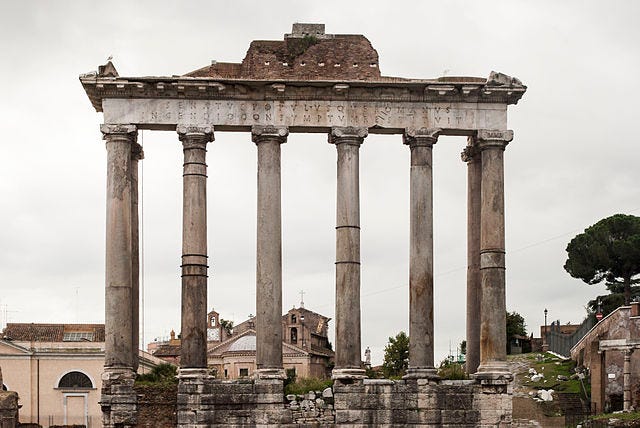
Being a pious person meant being moderate in all things, being careful with relationships, thoughts, and actions. As Seneca wrote, “speak with your fellow men as though in the hearing of the gods, and with the gods as though in the hearing of your fellow men.” In Rome, tradition was everything and everything had a tradition. Even the placement of the public treasury in the Temple of Saturn was based on the tradition that when Saturn lived in Italy, no one stole anything, and nobody owned anything. It was impious in the time of Saturn to mark off territory or possessions as being private property, and so, in turn, the public funds for the city of Rome were to be kept in the Saturn’s temple to remind those who would think of stealing its treasure of the dishonor they would bring on their heads and that of their families.
In this way, Hellenistic society maintained an equilibrium between the gods and humanity on one hand, and on the other, a sense of social cohesion in the face of tremendous diversity. Greece may not have been very diverse, but Rome and its empire were the very definition of a multi-racial, multi-ethnic polity, held together by pietas.[5]
Through this lens, we can appreciate what the Greeks and Romans thought of their myths, and, alternatively, how they expressed their spiritual life through rites and actions.
***
[1] Macrobius, Saturnalia 1, 7.18
[2] Tripolitis, Antonia. Religions of the Hellenistic-Roman Age. Wm. B. Eerdmans Publishing Company, November 2001. pp. 16–21.
[3] Giuseppe Barbera, Pietas: An Introduction to Roman Traditionalism. Mythology Corner, Wilmington, 2021, pp. 35-37.
[4] Merriam Webster: sac·ra·men·tal·ism ˌsa-krə-ˈmen-tə-ˌli-zəm. : belief in or use of sacramental rites, acts, or objects. specifically : belief that the sacraments are inherently efficacious and necessary for salvation.
[5] Pohl, Walter, "Romanness: a multiple identity and its changes". Early Medieval Europe, 2014, pp. 8-10
No Holy Scripture. Yes bloody sacrifice and scapegoating: regular, pious (this is the time to borrow the descriptor you used); nice; fine. Peaceful.
Those were the times, before the Abrahamists, and Christianity especially, replaced the piety and peace of selecting the most innocent and massacring them with the violence of doctrinal strife and power-seeking of orthodoxy.