

Mare Nostrum
The Rise and Fall of Rome’s Maritime Empire

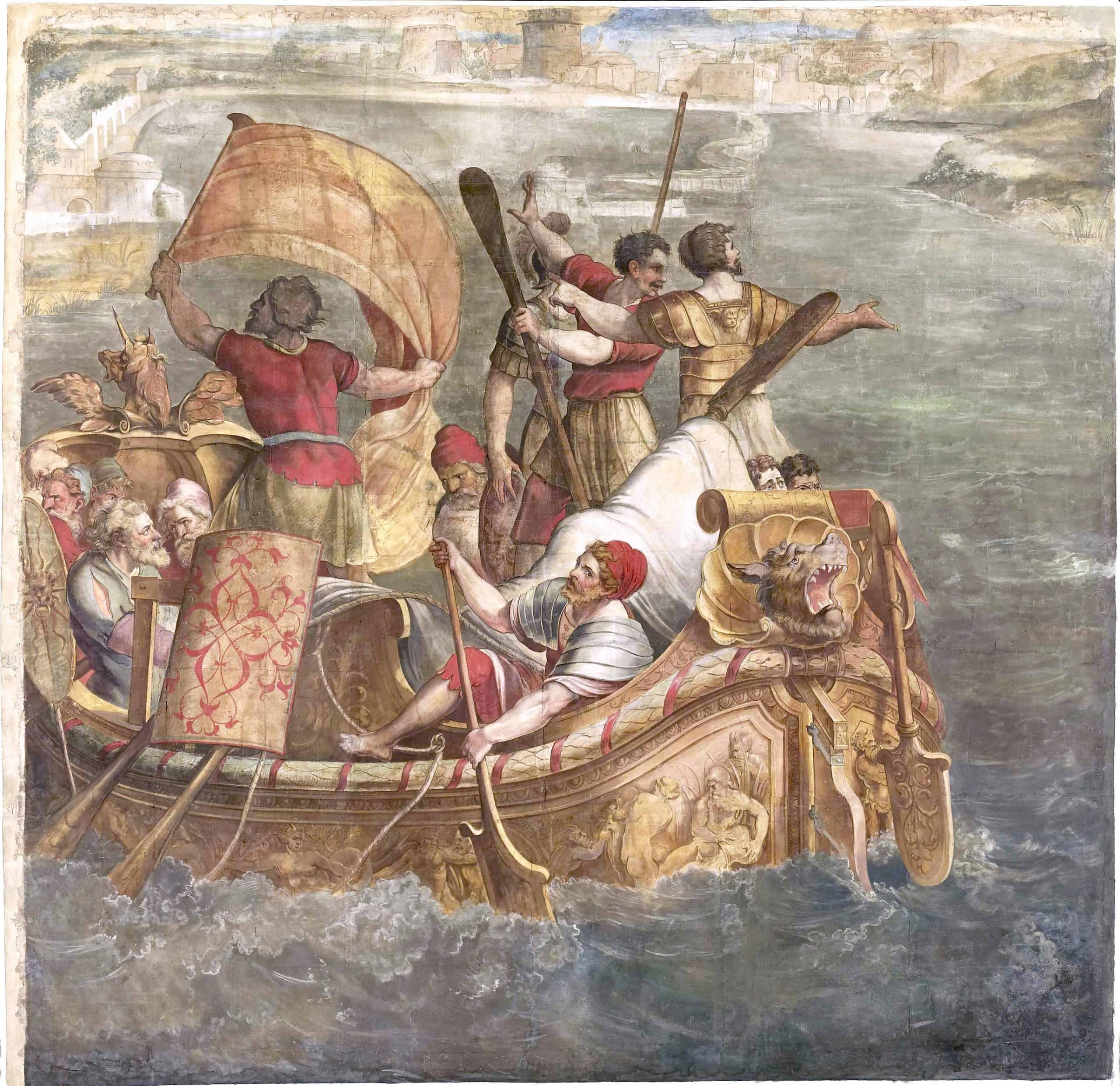
For a civilization that eventually branded the entire Mediterranean Sea as Mare Nostrum, or Our Sea, the early Romans had a hilarious aversion to salt water. In the early days of the Republic, a Roman citizen generally preferred to keep his feet firmly planted in the mud of the Tiber Valley. If a Roman had to travel by water, he preferred a sturdy bridge. However, the mid-third century BCE brought them into direct conflict with Carthage, the undisputed superpower of the Western Mediterranean. According to the historian Polybius in his Histories, Book 1, Chapters 20 to 21, the Romans did not even possess a single warship when the First Punic War broke out. Fortune favored them when a stranded Carthaginian quinquereme drifted onto the shores of southern Italy. The Romans, acting like historical corporate intellectual property thieves, copied the design plank for plank, building a fleet of one hundred quinqueremes in a matter of months. To make up for their complete lack of sailing experience, they invented the corvus, a heavy boarding bridge with a massive iron spike. Instead of outmaneuvering the nimble Carthaginian captains, Roman sailors simply rammed their bridge into the enemy deck, walked across, and turned a sea battle into a standard infantry brawl.
This rough-and-ready maritime engineering paid off handsomely. At the Battle of Cape Ecnomus in 256 BCE, described by Polybius in Book 1, Chapters 25 to 28, the Romans deployed over three hundred vessels to escort a massive invasion force to Africa. It remains one of the largest naval engagements in human history by headcount, and the Roman land-lubbing strategy triumphed, scattering the Carthaginian lines. The absolute climax of this long war, however, took place at the Battle of the Aegates Islands in 241 BCE. For decades, historians relied solely on texts to understand this clash, but recent underwater archaeology has vividly illuminated the battlefield. Excavations led by Sebastiano Tusa and the RPM Nautical Foundation off the coast of Sicily recovered numerous authentic bronze rostra, or naval rams, littering the seafloor (Tusa and Royal, 2012, pp. 7-12). These rams, weighing roughly one hundred and seventy kilograms each, show both Latin and Punic inscriptions, proving that the final Carthaginian defeat was a chaotic, high-speed demolition derby of splintering timber.
With Carthage subdued, Rome spent the next two centuries cleaning up the Mediterranean, but true uncontested maritime dominion arrived only after the Battle of Actium in 31 BCE. Here, the future Emperor Augustus pitted his agile liburnian galleys against the lumbering, tower-heavy floating fortresses of Mark Antony and Cleopatra. As Plutarch recounts in his Life of Antony, Chapter 66, Antony’s massive warships were so weighed down by artillery and marines that they could barely maneuver, allowing Octavian’s smaller vessels to swarm them like angry hornets. Cleopatra panicked, sailed away with her squadron, and Antony followed his heart and his fleet into historical ruin. Actium effectively ended the era of massive naval warfare in the Mediterranean because, quite simply, Rome had run out of enemies to fight.
With the seas cleared of both rival navies and pesky Cilician pirates, the Roman maritime culture shifted its focus from destruction to digestion. The empire became a massive stomach connected to the rest of the world by shipping lanes. The most vital component of this system was the merchant fleet, specifically the massive onerariae, or grain carriers, that kept the Roman proletariat fed through the annona grain subsidy. These vessels were the heavy-lifters of antiquity, some capable of carrying up to twelve hundred tons of wheat or thousands of terra-cotta amphorae filled with Spanish olive oil and garum, a pungent fermented fish sauce.
To handle this staggering volume of trade, Roman engineers reshaped the Italian coastline using a secret weapon: hydraulic concrete made with volcanic ash from Mount Vesuvius. This concrete hardened underwater, allowing for the construction of artificial harbors that defied the natural elements. Puteoli, located in the Bay of Naples, served as the primary deep-water port for centuries, its submerged waterfront bustling with merchants from Alexandria to Portugal (Tardugno, 2021, pp. 1-3). Later, the emperors Claudius and Trajan constructed an even grander complex called Portus Augusti just north of Ostia. Archaeological surveys of Portus show a massive hexagonal basin lined with grand warehouses, or horrea, where grain was weighed and stored under strict administrative eyes (Keay, 2019, pp. 152-156). For a Roman merchant captain, navigating these waters required a mix of luck and astronomical skill, especially since ancient ships lacked rudders and relied on twin steering oars that made parallel parking in a tight Mediterranean basin an absolute nightmare.
Nothing lasts forever, not even a monopoly on an entire sea. By the fifth century CE, the Western Roman Empire was fracturing under the weight of financial collapse and external migrations. As the city of Rome withered, the center of maritime gravity shifted decisively eastward to Constantinople. The Eastern Roman, or Byzantine, fleet took over the mantle of maritime control. The Byzantines maintained their grip on the eastern Mediterranean through technological innovation, most famously Greek Fire, a terrifying liquid flame thrown from bronze tubes on the bows of their dromon warships, which effectively turned enemy fleets into floating barbecues.
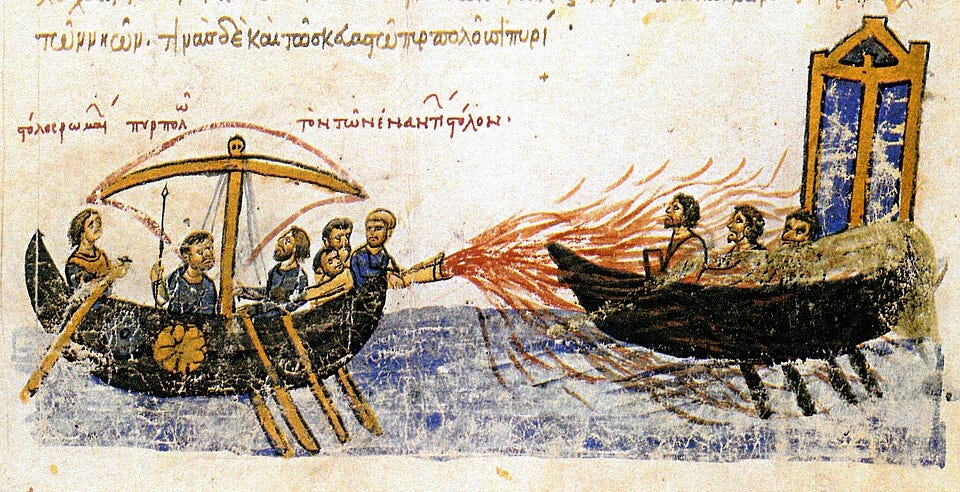
However, Byzantine naval hegemony gradually eroded as local administrative controls decentralized. By the high Middle Ages, the Italian peninsula birthed a new breed of maritime masters who cared far less about imperial majesty and far more about the bottom line. The maritime republics of Venice and Genoa emerged as the new titans of the Mediterranean. Venice, built literally on salt marshes, perfected the galley-based mercantile convoy, establishing trading posts across the Levant. Genoa countered with robust, heavily armed merchant carracks and a fierce banking system. Where the Romans used brute military force to integrate the Mediterranean basin into a single political sanctuary, the Venetians and Genovese used sharp contract law, superior naval archery, and financial networks to carve the sea into competitive commercial empires. The Pax Romana caved to the rule of the merchant princes, proving that while Rome could conquer the waves with iron and concrete, the sea ultimately belongs to whoever can keep the cargo flowing.
Bibliography
Keay, S. (2019). The Role Played by the Portus Augusti in Flows of Commerce between Rome and its Mediterranean Ports. Infrastructure and Distribution in Ancient Economies, 147-192.
Plutarch. (1920). Life of Antony. Parallel Lives (B. Perrin, Trans.). Harvard University Press.
Polybius. (1922). The Histories (W. R. Paton, Trans.). Harvard University Press.
Tardugno, M. L. (2021). Puteoli and the ripa puteolana: archaeological and geological insights into a submerged Roman waterfront. Annals of Geophysics, 1-12.
Tusa, S., & Royal, J. (2012). The landscape of the naval battle at the Egadi Islands (241 B.C.). Journal of Roman Archaeology, 25, 7-48.