
On Tyranny
The Greco-Roman view of tyrants

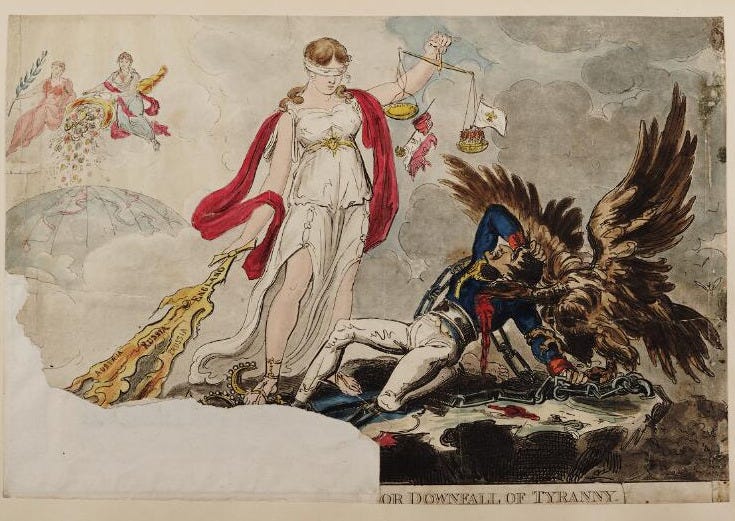
People have been living with tyrants for as long as we have been recording history. In ancient Greece and Sicily, the term was τύραννος (túrannos), meaning an absolute ruler. At first, the use of the word tyrant did not contain the negative connotation it later developed, nevertheless, the word has long meant to describe an illegitimate, cruel, and autocratic type of ruler.
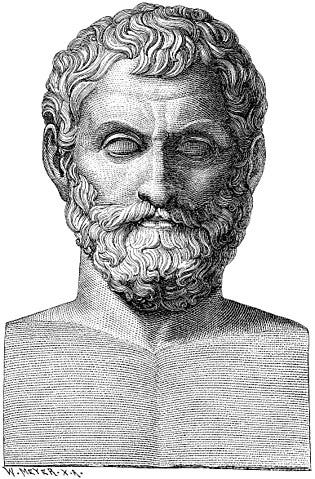
The word “tyrant” itself probably came from before ancient Greek, some point to the Lydian language, while others simple label it pre-Greek, or Pelasgian.[1] Whatever its origin, the meaning quickly came to identify the opportunistic and autocratic rulers who often gained power through extraordinary means. Greek tyrants were known also to maintain their power by hiring mercenaries from outside their city-state, thus illustrating the tenuous and usually unpopular grasp they often held over their subjects. Indeed, Diogenes Laertius tells us that the great Ionian pre-Socratic philosopher, Thales of Miletus, once quipped that “the strangest thing he had ever seen was an aged tyrant.”[2]
It is quite possible that the term “tyrant” did originate with the Lydians, simply because Lydia is one of the very first recorded instances of a tyrant coming to power through nefarious means. It was, after all, Gyges the tyrant who took control of Lydia by killing the king and marrying his queen. This sets the stage for the negative connotation we now associate with the word from the very start.[3]
By the 6th century BCE, we see another attribute of tyranny arise in the form of blatant treachery against one’s own people. By this time, there was an alliance of city-states led by Sparta, which opposed the tyrants and supported popular rebellions. During this period, the Persian empire often found allies in the tyrants who needed Persia to suppress popular revolts.
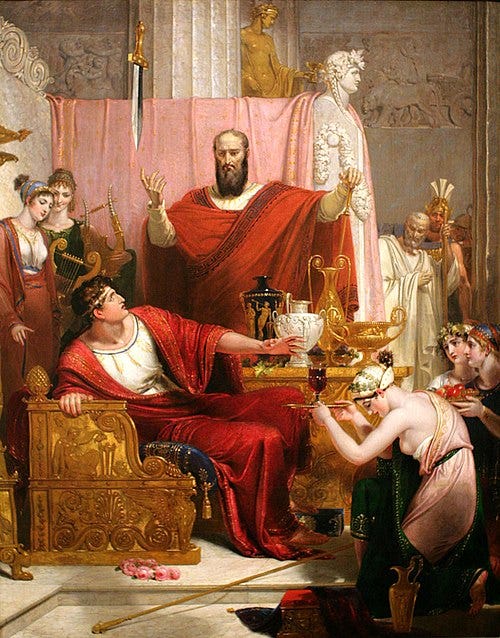
We see that the Greek and Sicilian tyrants created something of a poor track record when it came to their opportunism, treachery, brutality, and, eventually, their own peace of mind and mortality. Nowhere can we see the frail and pitiful nature of the tyrant better than in the person of Dionysius I of Syracuse. In Cicero’s Tusculan Disputations, the Roman statesman paints us a picture of the internal misery of the tyrant—no matter how rich and powerful he might have been:
This tyrant, however, showed himself how happy he really was: for once, when Damocles, one of his flatterers, was dilating in conversation on his forces, his wealth, the greatness of his power, the plenty he enjoyed, the grandeur of his royal palaces, and maintaining that no one was ever happier – ‘Have you an inclination,’ said he, ‘Damocles, as this kind of life pleases you, to have a taste of it yourself, and to make a trial of the good fortune that attends me?’ And when he said that he should like it extremely, Dionysius ordered him to be laid on a bed of gold with the most beautiful covering, embroidered and wrought with the most exquisite work, and he dressed out a great many sideboards with silver and embossed gold. He then ordered some youths, distinguished for their handsome persons, to wait at his table, and to observe his nod, in order to serve him with what he wanted. There were ointments and garlands; perfumes were burned; tables provided with the most exquisite meats. Damocles thought himself very happy. In the midst of this apparatus, Dionysius ordered a bright sword to be let down from the ceiling, suspended by a single horsehair, so as to hang over the head of that happy man. After which he neither cast his eye on those handsome waiters, nor on the well wrought plate; nor touched any of the provisions: presently the garlands fell to pieces. At last he entreated the tyrant to give him leave to go, for that now he had no desire to be happy. Does not Dionysius, then, seem to have declared there can be no happiness for one who is under constant apprehensions? But it was not now in his power to return to justice, and restore his citizens their rights and privileges; for, by the indiscretion of youth, he had engaged in so many wrong steps, and committed such extravagances, that had he attempted to have returned to a right way of thinking he must have endangered his life.
Yet, how desirous he was of friendship, though at the same time he dreaded the treachery of friends, appears from the story of those two Pythagoreans: one of these had been security for his friend, who was condemned to die; the other, to release his security, presented himself at the time appointed for his dying: ‘I wish,’ said Dionysius, ‘you would admit me as the third in your friendship.’ What misery was it for him to be deprived of acquaintance, of company at his table, and of the freedom of conversation; especially for one who was a man of learning, and from his childhood acquainted with liberal arts, very fond of music, and himself a tragic poet - how good a one is not to the purpose, for I know not how it is, but in this way, more than any other, everyone thinks his own performances excellent. I never as yet knew any poet (and I was very intimate with Aquinius), who did not appear to himself to be very admirable. The case is this; you are pleased with your own works, I like mine. But to return to Dionysius: he debarred himself from all civil and polite conversation, and spent his life among fugitives, bondmen, and barbarians; for he was persuaded that no one could be his friend who was worthy of liberty or had the least desire of being free.[4]
Thus, we see the misery the tyrant inflicts upon himself. We learn that through the millennia since this story was first told, the nature and destiny of tyrants is always the same.
Sic semper tyrannis.
***
[1] Forrest, George "Greece, the history of the Archaic period" in Boardman, John et al. (1986), The Oxford History of the Classical World (OUP)
[2] "LacusCurtius • Diogenes Laërtius: Thales
[3] Roberts, J. W., ed. (2005). "tyranny". The Oxford dictionary of the classical world. Oxford: Oxford University Press. ISBN 978-0-19-280146-3. Based on Herodotus, Histories 1.7–14
[4] Cicero, Tusculan Disputations, V. 61