
Pythagorean Harmonics
Weighing Hammers and Whirling Spheres with Nicomachus of Gerasa

The Manual of Harmonics by Nicomachus of Gerasa is a peculiar little volume that serves as a bridge between the rigid geometry of the early Pythagoreans and the more expansive musical theories of the late Roman Empire. In Flora Levin’s 1994 translation for Phanes Press, Nicomachus emerges not merely as a dry mathematician, but as a devoted enthusiast of the cosmic radio dial. For Nicomachus, the universe is not just organized; it is tuned. To open this manual is to step into a world where a wrong note is not just a musical error but a slight against the very fabric of reality (Nicomachus, Manual of Harmonics, 1).
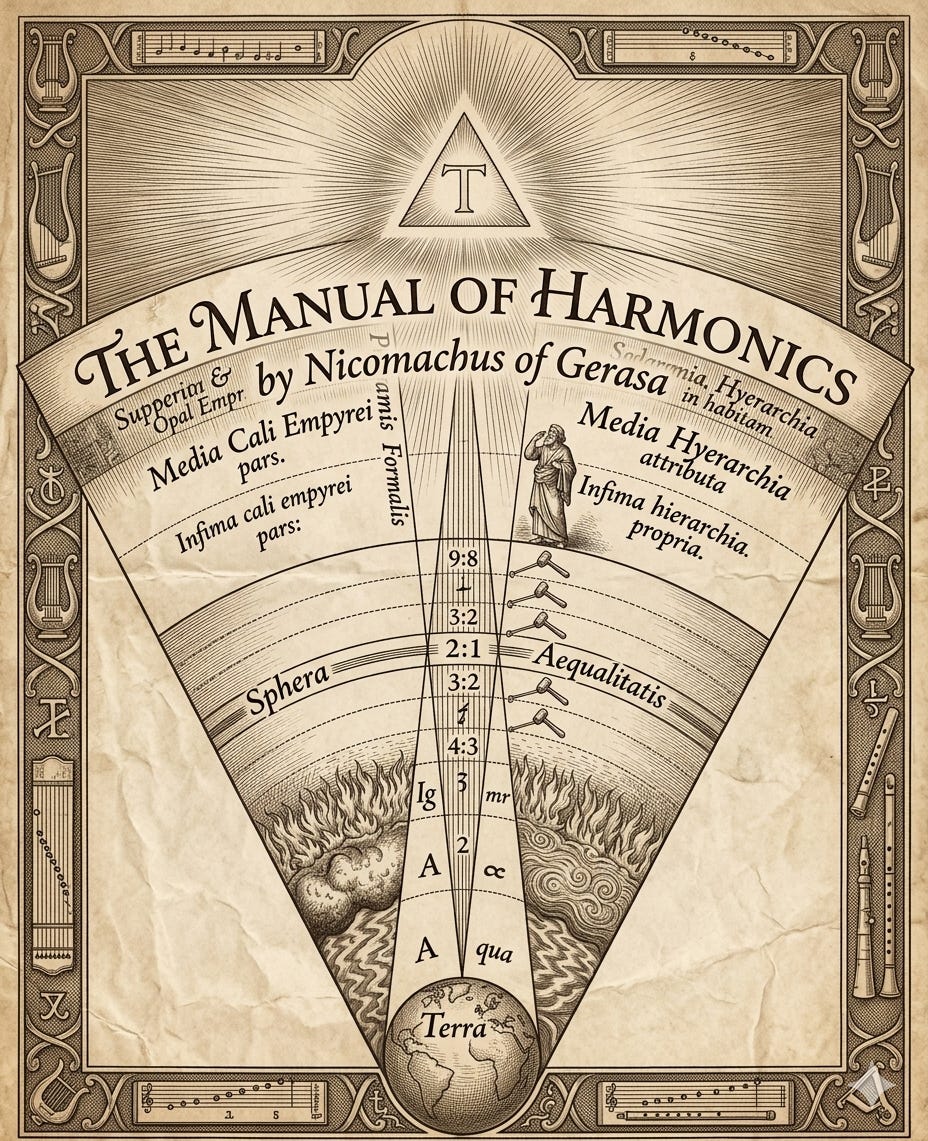
Nicomachus begins with the delightful premise that sound is the result of a physical strike, a collision that sets the air in motion. He invites his reader to imagine the celestial bodies—the planets and the stars—whirling through the ether at such incredible speeds that they must, by necessity, produce a hum of divine proportions. This is the fabled Music of the Spheres, though Nicomachus is quick to remind us that our human ears are far too coarse to pick up the broadcast. It is a bit like living next to a bustling highway and eventually ceasing to hear the traffic, except in this case, the traffic is the harmony of the gods (Nicomachus, Manual of Harmonics, 3).
The primary focus of the work is the relationship between number and sound, specifically the intervals of the octave, the fifth, and the fourth. Nicomachus treats these ratios—2:1, 3:2, and 4:3—with the kind of reverence a modern chef might reserve for a secret ingredient. He recounts the legendary, if perhaps apocryphal, story of Pythagoras passing by a blacksmith’s shop and noticing that hammers of different weights produced different pitches when struck against the anvil. By weighing the hammers, Pythagoras supposedly discovered the mathematical foundations of music (Nicomachus, Manual of Harmonics, 6).
While Nicomachus is our guide, he was hardly the only ancient voice obsessed with the vibrating string. In his Republic, Plato suggests that the study of harmonics is essential for the soul’s development, though he warns against those “laborious musicians” who spend all day torturing their instruments to find the smallest possible interval. Plato preferred the abstract beauty of the ratios over the messy reality of performance (Plato, Republic, 531b). Aristotle, in his usual grounded fashion, acknowledged the beauty of the Pythagorean system but remained skeptical about the actual noise produced by the stars, dryly noting that if the sun and moon made such a tremendous sound, we would likely be deafened by the sheer volume of it (Aristotle, On the Heavens, 290b).
Nicomachus, however, remains undeterred by such Aristotelian pragmatism. He guides us through the construction of the monochord, a single-stringed instrument used more for demonstration than for a weekend concert. By sliding a bridge along the string according to precise mathematical divisions, one can prove that the universe is governed by order. It is a comforting thought: no matter how chaotic the marketplace or the forum might become, a string divided exactly in half will always produce a perfect octave.
The manual eventually winds its way into the complexities of the various scales, but it never loses its sense of wonder. Nicomachus views the musician as a sort of cosmic technician, someone who uses the laws of arithmetic to harmonize the human spirit with the divine movement of the heavens. It is an amusing image to consider—a group of ancient students diligently measuring strings and weighing hammers, all in an attempt to catch a faint echo of a celestial symphony that they were told, from the start, they would never actually be able to hear.
Bibliography and further reading
Aristotle. On the Heavens. Translated by W. K. C. Guthrie. Loeb Classical Library. Cambridge: Harvard University Press, 1939.
Nicomachus. The Manual of Harmonics of Nicomachus the Pythagorean. Translated by Flora R. Levin. Grand Rapids: Phanes Press, 1994.
Plato. Republic. Translated by Chris Emlyn-Jones and William Preddy. Loeb Classical Library. Cambridge: Harvard University Press, 2013.