
Roman Viticulture
Resilient Vines, Brittle Bonds

The Roman viticulturist Columella once remarked that a vine-dresser should ideally be a man of such height that he could reach the top of the trellis without a ladder, yet many a Roman slave likely spent his days wishing for shorter vines and longer breaks (Columella, De Re Rustica, IV.1). This image of the towering, productive vine serves as a fitting metaphor for the Roman villa rustica, a structure that embodied the peak of ancient agrarian engineering while resting upon a foundation of profound human inequality. To understand the resilience of the Roman world, one must look not to the marble temples of the Forum, but to the functional, muddy, and highly sophisticated wine-producing estates that dotted the Italian and Gallic countrysides. These villas were not merely farms; they were the primary nodes of a Mediterranean-wide economic network, designed with a level of administrative logic that sought to harmonize the extraction of natural wealth with the rigorous management of human labor.
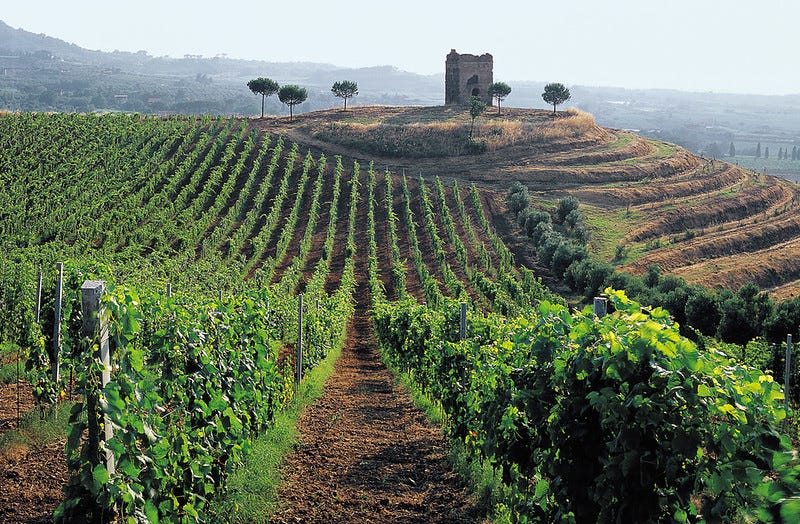
The resilience of the villa rustica lay in its architectural and systemic integration. As Marcus Terentius Varro suggests in his Res Rusticae, the successful villa was a machine for turning soil, sunlight, and sweat into liquid capital (Varro, Res Rusticae, I.1). Varro emphasized that the location of the villa was the first step in ensuring its longevity. It had to be situated near a road or a navigable river to ensure that the heavy amphorae of wine could reach the markets of Rome or the military camps on the Rhine. A villa that could not export its surplus was a fragile entity, but one integrated into the imperial logistics chain possessed a structural durability that allowed it to survive local crop failures or market fluctuations. This connectivity allowed the Roman economy to function as a polycentric system, where the health of the center depended entirely on the productivity of these rural outskirts.
Architecturally, the villa rustica was divided into three distinct zones that reflected its dual nature as both a home and a factory. The pars urbana served as the owner’s residence, while the pars rustica housed the staff and livestock. However, the heart of the estate’s resilience was the pars fructuaria, the production zone. Here, the Romans employed a level of technical sophistication that would not be surpassed for a millennium. In the torcularium, or pressing room, massive lever-and-screw presses extracted the juice of the grape with clinical efficiency. Cato the Elder, in his manual De Agri Cultura, provides incredibly granular instructions on the construction of these presses, detailing the exact types of wood and stone required to ensure the equipment did not fail during the high-pressure environment of the vintage (Cato, De Agri Cultura, XVIII). This focus on the durability of the tools was a direct reflection of the Roman desire for an unbreakable production cycle.
The resilience of these estates also extended to their ecological management. The Roman agronomists were early proponents of what might now be termed integral development, recognizing that the long-term health of the vineyard depended on the replenishment of the soil. Columella, writing in De Re Rustica, argued against the idea that the earth was “growing old” or becoming weary (Columella, De Re Rustica, II.1). Instead, he insisted that declining yields were the result of human negligence and a failure to apply proper fertilizers. The villa rustica was designed to be a closed loop where animal manure from the stables was systematically returned to the vines, and the remains of the pressed grapes were used as fodder or even as a low-quality wine for the workers. This focus on maintaining the ontological dignity of the land—even if the Romans did not use that specific phrasing—ensured that many of these estates remained productive for centuries, outlasting the very political structures that birthed them.
However, the narrative of the resilient villa is incomplete without addressing its profound negative aspects. The stability of the Roman wine industry was purchased at the cost of human autonomy. The villa rustica was, in many ways, a precursor to the plantation system, where the administrative logic of the estate-owner reduced the personhood of the laborer to a mere instrumentum vocale, or a “speaking tool.” Varro’s classification of agricultural equipment into three categories—the articulate (slaves), the inarticulate (oxen), and the mute (carts)—reveals the cold, dehumanizing framework that underpinned the entire system (Varro, Res Rusticae, I.17). While the villa was resilient as an economic unit, it was socially brittle. The reliance on forced labor meant that the threat of rebellion or sabotage was a constant background noise to the sounds of the harvest.
Furthermore, the Roman obsession with efficiency often led to a monocultural landscape that was vulnerable to specific environmental shocks. In the pursuit of the highly profitable Falernian or Caecuban wines, large swathes of diverse Mediterranean scrubland were cleared for trellised rows. While the Romans understood soil health, they were less aware of the long-term impacts of deforestation and the erosion that followed the intensive cultivation of hillsides. The very landscape that made the villa possible was often permanently altered by its presence, leading to a type of environmental degradation that eventually made the traditional villa model unsustainable as the Empire’s borders began to contract and the security of the export routes failed.
Another negative aspect was the corruption of the Roman social fabric caused by the concentration of land in the hands of the elite. The growth of the latifundia, or large-scale slave estates, often came at the expense of the small-scale free farmer. As the villa rustica became more resilient and technologically advanced, it crowded out the traditional peasantry, leading to the massive urbanization of the Roman poor and a subsequent reliance on the state grain dole. The dignity of the person was sacrificed on the altar of economies of scale, creating a society that was top-heavy and increasingly prone to internal collapse despite the outward appearance of agricultural abundance.
The technical legacy of the villa rustica, however, is undeniable. When the Western Empire finally dissolved, the physical structures of the villas often fell into ruin, but the methodology of the vine survived. The knowledge of grafting, pressing, and fermentation was preserved within the walls of monastic communities, which adopted the Roman administrative model but infused it with a different social and spiritual purpose. This transmission of knowledge allowed the European wine industry to retain its classical roots, ensuring that a modern glass of Burgundy or Chianti still carries the DNA of the Roman torcularium. The resilience of the vine itself, a plant that thrives in poor soil and requires constant human intervention to reach its full potential, serves as a lasting testament to the Roman ability to shape the natural world to their will.
In reflecting on the villa rustica, we see a system that achieved a remarkable balance between technological innovation and environmental management, even as it failed the basic test of human justice. It was a multifaceted world where the local estate was the primary unit of survival, yet it remained intimately connected to a global whole. For the modern researcher, the lesson of the villa is that resilience cannot be measured by production figures alone; it must also be measured by the stability of the social bonds that hold the system together. The Roman villa was a masterpiece of administrative logic, but its failure to recognize the inherent dignity of all its inhabitants meant that its resilience was ultimately a temporary shield against the inevitable tides of history.
Bibliography and further reading
Cato the Elder. De Agri Cultura. Translated by W. D. Hooper and H. B. Ash. Loeb Classical Library. Harvard University Press, 1934.
Columella. De Re Rustica. Translated by Harrison Boyd Ash. Loeb Classical Library. Harvard University Press, 1941.
Pliny the Elder. Naturalis Historia (Book XIV). Translated by H. Rackham. Loeb Classical Library. Harvard University Press, 1945.
Varro, Marcus Terentius. Res Rusticae. Translated by W. D. Hooper and H. B. Ash. Loeb Classical Library. Harvard University Press, 1934.
White, K. D. Roman Farming. Cornell University Press, 1970.