
The Mirror of Diana
The Sacred Lake, Grove & Sanctuary of Diana Nemorensis

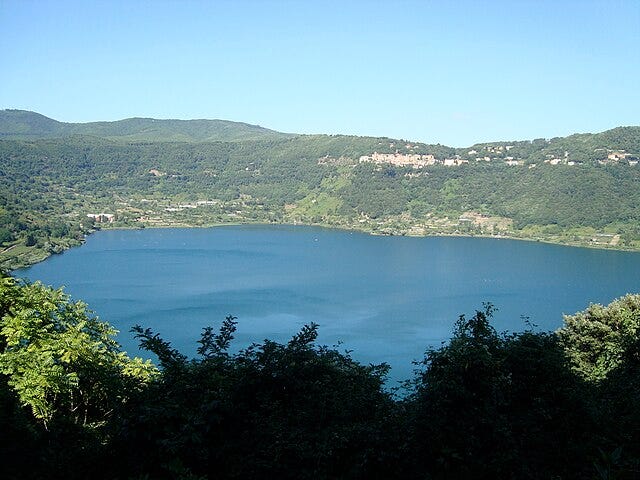
In the mists of a sylvan road at the 16th milestone on the Via Appia from Rome, a sacred grove is nestled along a lake called Nemi (Italian: Lago di Nemi; Latin: Nemorensis Lacus). In ancient times, this place was better known as the Speculum Dianae, the “Mirror of Diana”, owing to the round shape of the lake. Under the shimmering natural beauty of this lake, there is a very ancient and controversial history that involves great Homeric heroes and human sacrifice.
To understand the cultural significance of this woodland grove, we must travel more than 2,000 miles to Crimea. There, surrounded by the Black Sea, was the city of the mythical king Thoas of the Taurians (a people integrated into the Scythian culture). Some said he was the son of Dionysos and Ariadne, but Thoas is better known for being one of the heroes who fought for the Greeks in the Trojan War.
According to the Greek geographer Strabo (64 BCE – 24 CE), the Greeks and Italians got the cult of Tauric Artemis from the Scythians who inhabited the Crimean Peninsula. It was thought that her cult was brought to Anatolia, Greece, and Italy, by the Homeric hero Orestes and his sister Iphigeneia.[1] Furthermore, it was reported by Philostratus (170-240 CE) that this cult involved the use of human sacrifice, which was later “turned into a contest of endurance.”[2]
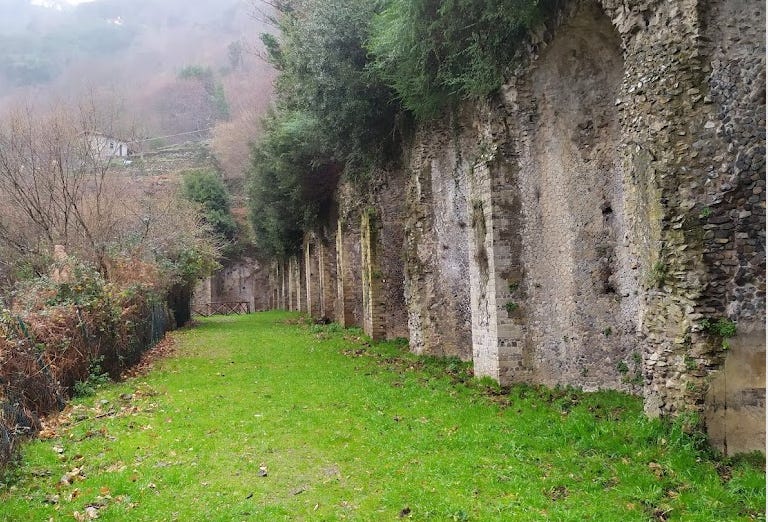
Recent scholarship, using vase-paintings and literary evidence, has tied the Tauric Artemis to the foundation of Diana’s temple at Nemi to at least the 4th century BCE, though the cult is likely much older. Unlike the tragedy Iphigeneia by Euripides, according to some myths, King Agamemnon’s daughter Iphigeneia was not sacrificed to Artemis, instead the virgin huntress accepted a deer in her place, and whisked her off to the court of Thoas in Crimea.[3] Interestingly, there is still more evidence to show that Taurians, whether led by Thoas or not, had established a colony on the southwestern coast of Italy and northern Sicily during this time period.[4]
What is curious about the translation of the cult of Tauric Artemis to Italy is the initial horror the Romans felt when they saw that this cult included human sacrifice. In both Euripides’ play Iphigeneia, and Virgil’s Aeneid, there are references to human sacrifice.[5] In the writings of the 4th century commentator, Servius, he mentions that it was Agamemnon’s son—Iphigenia’s brother—Orestes, who took the idol of Tauric Artemis to the village of Aricia on Lake Nemi.[6] Thus, the cult of Diana Nemorensis likely originated with Tauric Artemis beginning in the 6 century BCE. [7] [8]
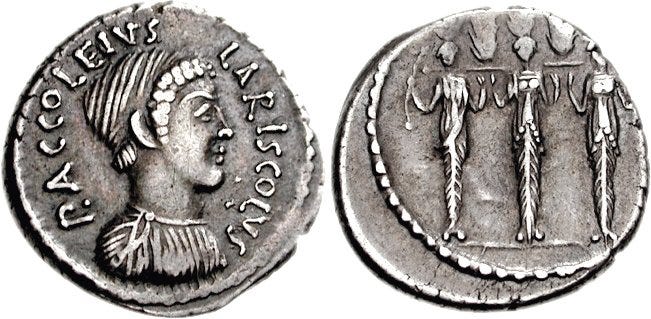
The Sanctuary of Diana-in-the-Wood, as it is also known, was established on the shores of Lake Nemi in a sacred grove. The statue of the goddess was placed in the grove, and a sanctuary was built in the Etruscan era. We know this because the Roman architect Vitruvius noted in the 1st c. BCE that the temple at Nemi was “archaic” and “Etruscan in its form.”[9] The archaic cult image probably stood in the temple until at least 43 BCE, owing to the fact that it appeared on coins until that time. Diana’s archaic image followed the Etruscan Trivia or Diva triformis goddess motif, a “threefold unity of the divine huntress, the Moon goddess, and the goddess of the nether world, Hekate.”[10]
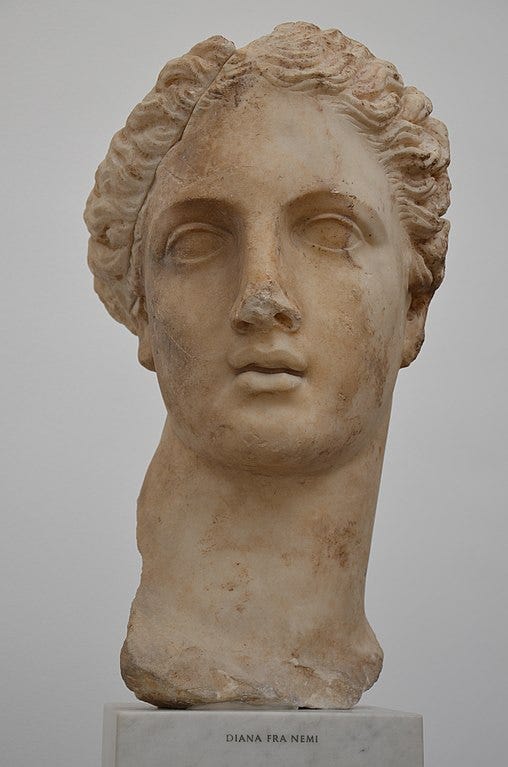
The ritual leader of the cult of Diana Nemorensis was the so-called King of Nemi, a priest of Diana. This priest-king was in charge of the sacred grove and its sanctuary, as well as a theatre and a considerable treasury amassed over the centuries. The kings of Nemi were also responsible for guarding the sacred oak which was located in the middle of the grove. According to tradition, no one was allowed to break off a branch of this sacred tree except for a runaway slave. The slave would break off a branch, signaling that he would enter into mortal combat with the king. If the slave killed the king, he would become the new King of Nemi.
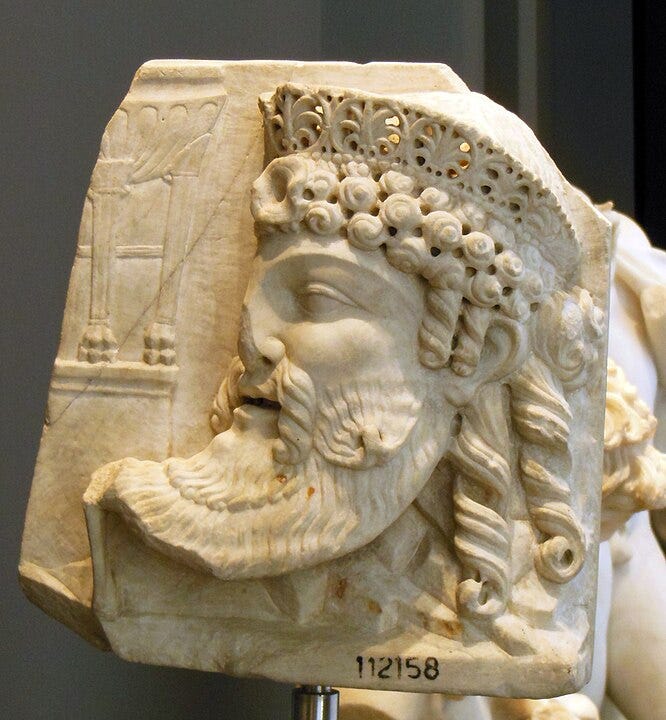
This ritual combat is thought to be the way human sacrifice was turned into a contest of endurance, as reported earlier by Philostratus. Strabo tells us:
“And in fact a barbaric, and Scythian, element predominates in the sacred usages, for the people set up as priest merely a run-away slave who has slain with his own hand the man previously consecrated to that office; accordingly the priest is always armed with a sword, looking around for the attacks, and ready to defend himself.”[11]
The origin and relevance of the flight of the slave and the plucking of the Golden Bough may be related to the myth of the flight of Orestes and Iphigeneia.[12] In any event, this trial by combat continued well into the classical period, when it became something of a gladiatorial show for the emperor Caligula.[13]
Just imagine that over the course of more than a thousand years, this grove and lake were not only hallowed ground, but ruled by runaway slaves who had, one after the other, struck down their predecessors among the sacred oaks. Next to the shining Mirror of Diana, the goddess and her oak nymphs, known as the Querquetulanae, granted untold generations good hunting, fertility, and easy delivery of newborns, all for the price of a little blood.
***
[1] Strabo, Geography 12. 2. 3
[2] Philostratus, Life of Apollonius of Tyana 6. 20 (trans. Conybeare)
[3]Stasinus of Cyprus or Hegesias of Aegina, Cypria Fragment 1 (from Proclus, Chrestomathy 1) (trans. Evelyn-White) (Greek epic C7th or 6th B.C.)
[4] Cato the Elder, Origines, fr. 71
[5] Aeneid, 2.116 deals with human sacrifice.
[6] Servius as quoted in Edith Hall, “Visualising Euripides’ Tauric Temple of the Maiden Goddess.” (See below)
[7] Edith Hall, “Visualising Euripides’ Tauric Temple of the Maiden Goddess”, Ancient Theatre and Performance Culture around the Black Sea, Cambridge University Press, Cambridge (UK), 2019, pp. 313-315.
[8] Gordon, A.E. (1932). "On the Origin of Diana", Transactions and Proceedings of the American Philological Association 63 (1932, pp. 177-192) p 178.
[9] Vitruvius, 4.8.4.
[10] Alföldi, "Diana Nemorensis", American Journal of Archaeology (1960:137-44) p 141.
[11] Strabo, Geographia, V, 3, 12.
[12] Maurus Servius Honoratus, Commentary on the Aeneid, 2.116 & 6.136
[13] Gaius Suetonius Tranquillus, Life of Caligula, 35.