
The Mystery Critic
The Unknown Author of "On the Sublime"

It is an amusing quip of history that one of the greatest literary critics of the classical period is unknown to us. We have a name–though it is likely not the real name of our critic. Indeed, his identity is one of the great mysteries of classical literary criticism.
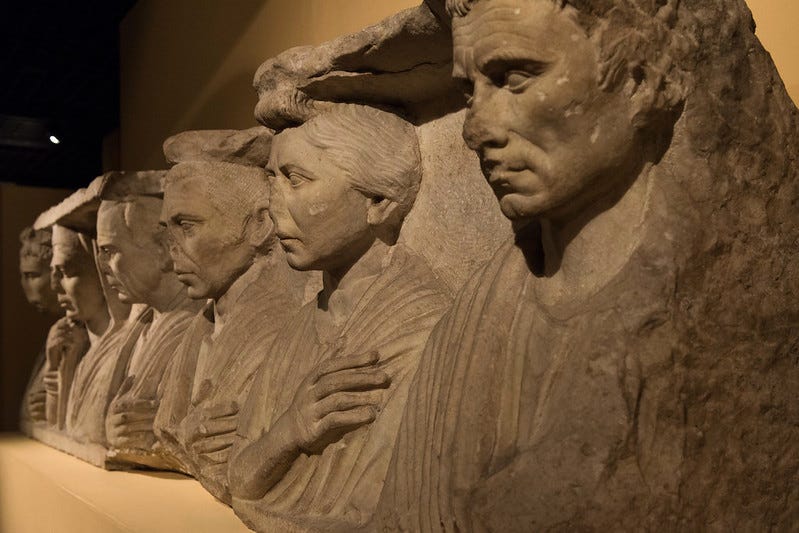
Thankfully, we possess the book this mystery critic penned, though we know very little about his life. We do know that this Longinus is the author of one of the most influential treatises on classical literature, which is titled On the Sublime (Greek: Περì Ὕψους Perì Hýpsous); Latin: De sublimitate. This work is often ranked second only to Aristotle’s Poetics. Unlike Aristotle’s analytical approach, however, Longinus was interested in a specific quality in writing: the sublime. The sublime, as defined by Longinus, is a style of writing that elevates the reader to a state of awe and ecstasy. He identified five sources of the sublime: Great thoughts, strong emotions, figures of speech, noble diction, and dignified word arrangement.
Longinus’s work emphasizes the power of emotion and the importance of both innate genius and learned skill in a writer. He believed that the sublime was an “echo of a great soul,” transcending technical rules to inspire and move the audience on a deep, emotional level. His focus on the emotional impact of literature was a major influence on the Romantic movement centuries later.
The traditional attribution to Cassius Longinus, a 3rd-century CE philosopher, is now widely disputed by scholars. It is generally accepted that the author lived much earlier, likely in the 1st century, possibly under a different name, or perhaps even using “Longinus” as a pseudonym. According to the scholarship of the noted Byzantinist, Carlo Maria Mazzucchi, the author’s name was “Dionysius Longinus”, and his name was mistakenly recorded by a copyist. (See: Dionisio Longino (2010). Mazzucchi, Carlo Maria (ed.). Del Sublime (2nd ed.). Milan: Vita e Pensiero. pp. XXIX–XXXVII.)
Based on internal evidence within On the Sublime, such as references to contemporary and earlier authors and oratorical styles, most scholars place the author in the 1st century. This would make him a contemporary of figures like Seneca or Quintilian.
Regardless of his identity, the author was clearly a person of immense erudition. On the Sublime demonstrates a deep familiarity with a vast range of Greek and Roman literature, philosophy, and rhetoric. He quotes and discusses Homer, Plato, Demosthenes, Sappho, and even mentions Genesis from the Hebrew Bible, showing a broad cultural scope.
Given the subject matter of his treatise, it is most probable that Longinus was a rhetorician, a philosopher, or someone deeply involved in the teaching and practice of eloquence and literature. His insights into the mechanics of compelling writing suggest a practical understanding of composition.
The treatise itself is addressed to a certain “Postumius Florentinus,” and appears to be a response to a work on rhetoric by Caecilius of Calacte, which Longinus found inadequate in addressing the quality of “sublimity.” This suggests a context of learned discussion and debate among intellectuals of the time.
Despite the anonymity surrounding his life, Longinus achieved posthumous fame through On the Sublime. His ideas on the emotional power of language, the importance of inspiration, and the concept of the sublime itself profoundly influenced later literary movements.
The life of Longinus is primarily defined by his brilliant and enduring work. We know the profound impact of his thought, even if the man himself remains a shadow in the annals of history.
***
Bibliography and Further Reading
Pseudo-Longinus. On the Sublime. Translated by W. Hamilton Fyfe, revised by Donald Russell. Loeb Classical Library, Harvard University Press, 1995.
Laird, Andrew, editor. Classical Literary Criticism. Cambridge University Press, 2011.
Clark, Michael J., and Michele Kennerly, editors. The Oxford Handbook of Rhetorical Studies. Oxford University Press, 2017.