
The Saturnalia
Feast of the Golden Age

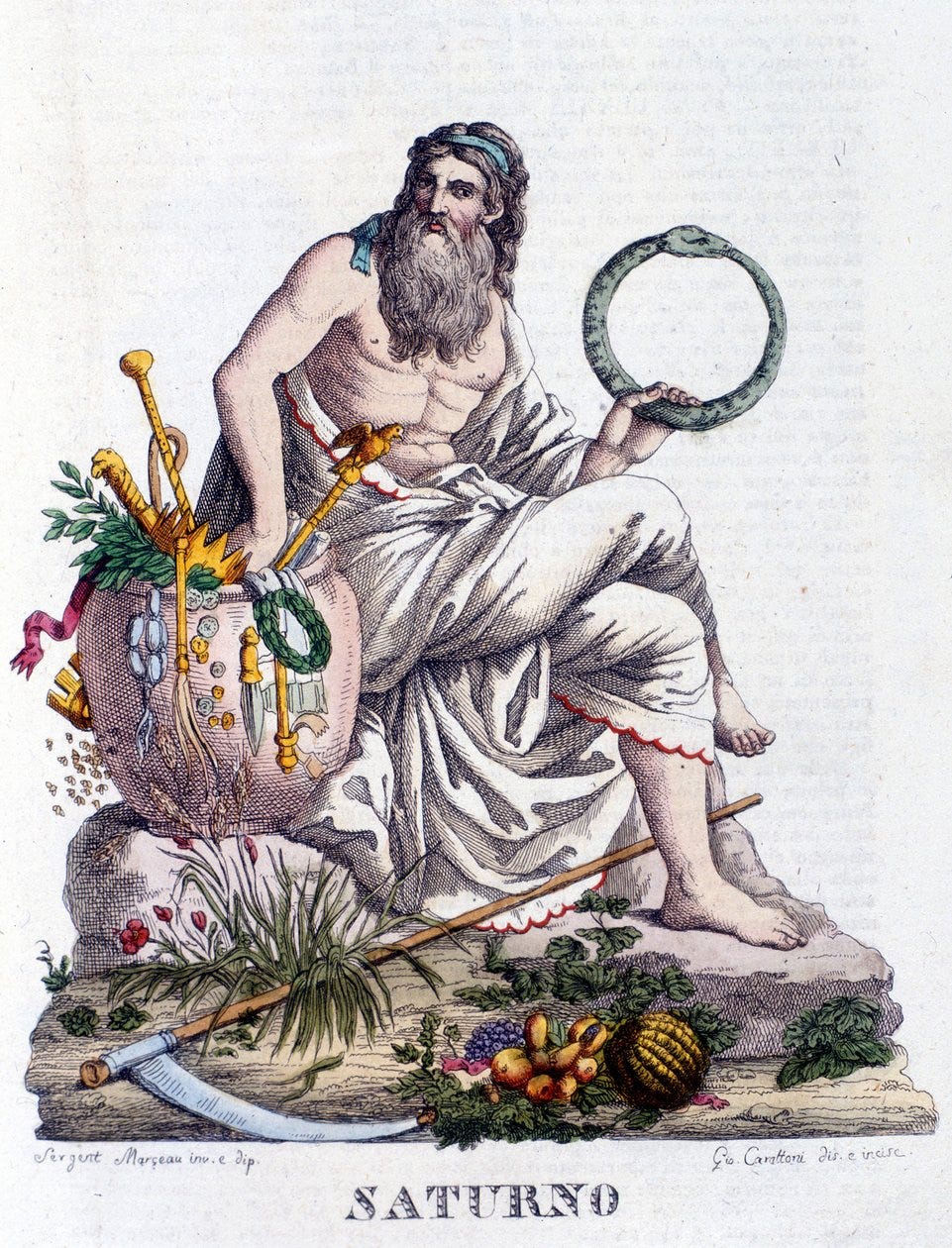
If we cast our minds back to the age when humanity was young, still hunting and gathering, we begin to catch a glimpse of the golden age of Saturn (Greek: Kronos)—king of the Titans, god of time, and father of Jupiter/Zeus and his divine sisters and brothers. For the Italic tribes living west of the Greek world, Saturn was also the god of agriculture and the seasons. His relationship to time is therefore relevant to all these attributes, both Greek and Italic.
Hesiod recounts:
“First of all, the immortals who dwell in Olympian homes brought into being the golden race of mortal men. These belonged to the time when Kronos ruled over heaven, and they lived like gods without any care in their hearts, free and apart from labor and misery. Nor was the terror of old age upon them, but always with youthful hands and feet they took their delight in festive pleasures apart from all evil; and they died as if going to sleep.”[1]
Hesiod’s Story of the Ages of Man goes on to tell us that during this golden age, humanity lived off of the abundance of the earth in perfect harmony with the gods, the earth, and each other.
The myths of Saturn vary greatly, but in Italy the tradition, which was well understood by the Romans, tell us that after having been deposed by his son Jupiter/Zeus and his Olympian children, Saturn was for a time banished to Tartarus in the underworld, but was then released[2] and made king of the Isles of the Blessed, lying west of Greece.
The Roman grammarian and antiquarian, Macrobius Ambrosius Theodosius (better known as “Macrobius”), gives us a detailed look at what the Romans of the late Classical period believed about Saturn and Saturnalia. This study took the form of Saturnaliorum Libri Septem, “Seven Books of the Saturnalia”, known simply as the Saturnalia today, and it encompasses the history, myths, and traditions of the cult of Saturn in Italy.
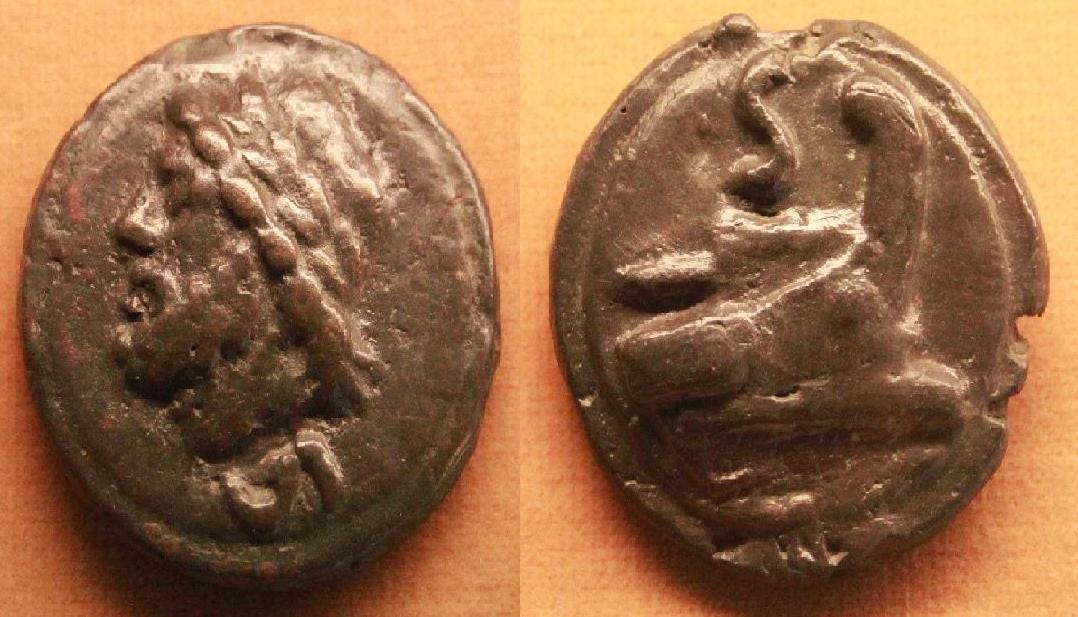
Macrobius relates that the region now called Italy was ruled by Janus the god of transitions, who received Saturn with open arms when he arrived on the shores of Italy by ship. From this, we may deduce that Macrobius is referring to the release of Kronos from Tartarus, and his voyage to the western Isles. This is interesting, because according to legend the first coin minted in Italy by Janus featured the head of himself and the reverse depicted a ship, thus giving meaning to the Roman idiom “heads or ships” when flipping a coin.[3] To honor Saturn, Janus for a while made him joint ruler, during which time the god offered his knowledge of agriculture and civilization-building.
Diodorus Siculus recorded:
"Kronos (Cronus) [here the Italian Saturnus], since he was the eldest of the Titanes (Titans), became king and caused all men who were his subjects to change from a rude way of living to civilized life, and for this reason he received great approbation and visited many regions of the inhabited earth. Among all he met he introduced justice and sincerity of the soul, and this is why the tradition has come down to later generations that he men of Kronos' time were good-hearted, altogether guileless, and blest with felicity. His kingdom was strongest in the western regions, where indeed he enjoyed his greatest honor; consequently, down even to comparatively recent times, among the Romans [called by them Saturnus] and the Carthaginians [elsewhere the author mentions the Carthaginian sacrifice of children to the god], while their city still stood, and other neighboring peoples, notable festivals and sacrifices were celebrated in honor of this god and many places bore his name.”[4]
We can appreciate that for the Italic tribes of the archaic period, the relationship between time, seasons, agriculture, and human history were well entwined, thus the conflation of Kronos and Saturn seems to have made a lot of sense.
“By Saturnus [Kronos] again they denoted that being who maintains the course and revolution of the seasons and periods of time, the deity so designated in Greek, for Saturnus' Greek name is Kronos (Cronus), which is the same as khronos, a space of time. The Latin designation ‘Saturnus’ on the other hand is due to the fact that he is ‘saturated’ or ‘satiated with years’ (anni); the fable is that he was in the habit of devouring his sons--meaning that Time devours the ages and gorges himself insatiably with the years that are past. Saturnus is bound by Jove [Zeus] in order that Time's courses might not be unlimited, and that Jove might fetter him by the bonds of the stars.”[5]
At a certain point during their joint reign, Saturn suddenly disappeared, leaving Janus to do him the honor of establishing the Saturnalia as a feast in December to commemorate his many gifts to their land.[6] Thus, the legends of the Italic peoples were full of interesting tidbits of information on what, exactly, Saturn did for them during his reign. Among some of the stories we can include the discovery of honey and many fruits, as well as Saturn’s epithet in Latin, Sterculius, the one who brought knowledge of using fertilizer (Latin: stercus).[7]
Between Saturn’s life-giving agriculture and his association with time, seasons, and fertile lands, it is not a long logical leap to understand that some of the first sacrifices to him would have been human victims. The Etruscan town called Saturnia vanquished its enemies by following the words of the Oracle, which instructed them to send the heads of their enemies to Hades, and a man (phôta)[8] to Father (meaning Saturn). Here, we can assume the heads were put on spikes and the man was sent as a victim to sacrifice.
Upon returning through Italy from one of his many adventures, Macrobius tells us that Hercules taught the locals of Saturnia to replace the ill-omened severed heads with masks or effigies (oscilla), and to replace the human sacrifice with the ritual kindling of lights at Saturn’s altar, as well as giving lights to one another during his feast days (See note 8 on the word phôta). The tradition was continued by the Romans, who offered gifts of elaborate oscilla and lamps as Saturnalia gifts.
Still other myths draw attention to the fact that the gift of lights during Saturnalia represents the transition out of the barbaric darkness of our human past, and Saturn’s gift of bringing us into the light of the knowledge of beneficial skills.[9] Either way, by the Classical period, the feast of Saturnalia was celebrated between 17 and 23 December. During the festival, slaves were treated as free citizens, and the days and evenings were filled with feasting, drinking wine, gambling, and the giving of gifts. In this way, the people of Rome would remember the golden age when mortals did not have to work, nor did anyone own anything.
How we wish to look back on this important feast for Saturn, whether as a dark and bloody sacrifice, or a golden, illuminated season of gift-giving and feasting, the root is the same. The gifts of our past reflect the needs and limitations of the present. The lights along our long path as mortals will always recall some distant time when a being greater than ourselves brought us from the darkness into the light.
Happy holidays to you all, and I look forward to a new year filled with more adventures in ancient Greek and Roman history, literature, mythology, and religion!
***
[1] The Poems of Hesiod, (R.M. Frazer, trans.) University of Oklahoma Press, Norman and London (1983), p. 101.
[2] Homer, Iliad 8. 479 ff
[3] Macrobius, Saturnalia, 1. 7.19-23
[4] Diodorus Siculus, Library of History 5. 66. 4 (trans. Oldfather) (Greek historian 1st c. BCE)
[5] Cicero, De Natura Deorum 2. 24 (trans. Rackham) (Roman rhetorician 1st c. BCE)
[6] Ibid. Macrobius, 1. 7.23-26
[7] Macrobius, 1. 7-23-26
[8] Phôta is both the accusative (objective case) singular of phôs = “man” and the nominative/accusative plural of phôs = “light” (a contracted form of phaos used in the Attic dialect).
[9] Macrobius, 1. 7.32-36