
Cow-eyed Hera
Goddess of the Cycles of Nature and Preserver of the Essential Nature of All Beings

Hera occupies a position of profound antiquity within the Greek pantheon, with her name appearing on Linear B tablets from Pylos and Knossos well before the formalization of the Olympian system in the works of Homer and Hesiod. As we previously discovered in my article Bovine Lore in Ancient Greece, the epithet “cow-eyed” is most famously and primarily attributed to the goddess Hera within the Homeric epics. In the original Greek, the term used is boopis (βοῶπις), a compound of bous (cow/ox) and ops (eye/face), which is frequently rendered in English translations as “cow-eyed” or “ox-eyed.”
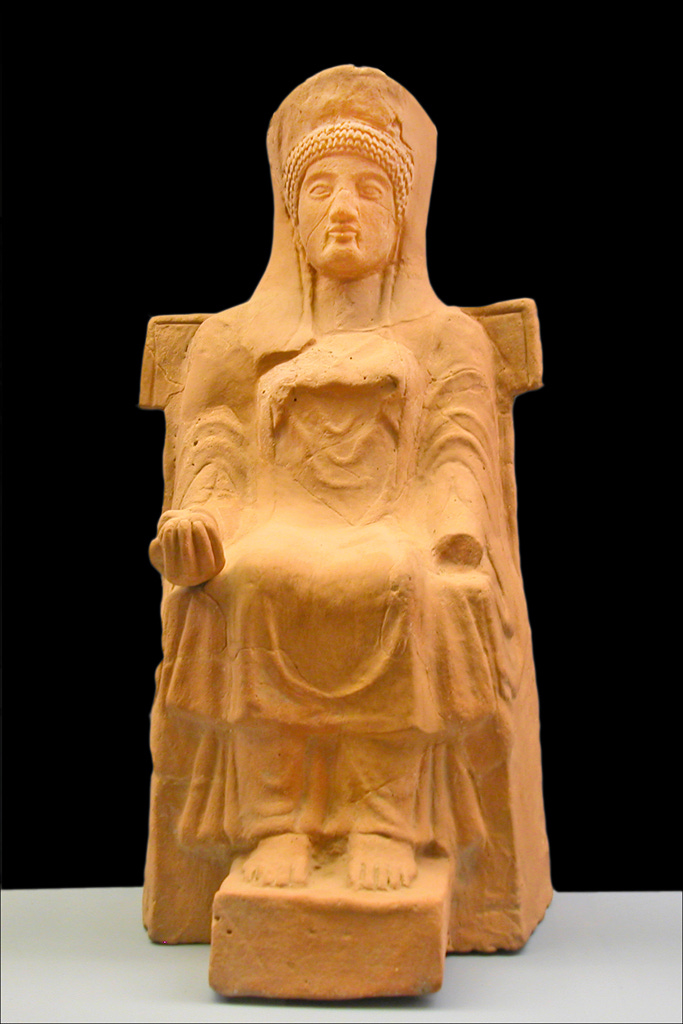
The primary occurrence of this description is found in the Iliad, where it serves as a fixed formulaic epithet to characterize Hera’s majestic and sovereign presence. It appears most notably in the phrase boopis potnia Here (βοῶπις πότνια Ἥρη), translated as “cow-eyed lady Hera” or “ox-eyed queen Hera”.1 This designation is used repeatedly throughout the epic to emphasize her large, dark, and beautiful eyes, which were considered a mark of divine beauty and power in the archaic period. For instance, in Book IV, when Hera addresses Zeus regarding the fate of Troy, she is again identified by this title as she asserts her status as the eldest daughter of Kronos.2
While the Iliad is the most prominent source, the epithet also appears in other early hexameter poetry. In the Theogony, Hesiod uses boopis to describe several female figures of high status, reinforcing the idea that the term denoted a specific kind of regal beauty rather than a literal bovine resemblance.3 Furthermore, in the Homeric Hymn to Apollo, the goddess is referred to as “cow-eyed, mighty Hera” during the narrative of her anger toward Zeus regarding the birth of Athena.4
While often reduced in popular mythology to the role of a jealous wife, scholarly analysis suggests she was originally a powerful, independent deity presiding over the cycles of female life and the fertile lands of Argos and Samos. As Joan Breton Connelly notes, Hera’s early sanctuaries, such as the Heraion of Argos, predated the monumental temples of Zeus, indicating her primary status in the early Iron Age.5 Her name is etymologically linked to hora, meaning season or the “right time,” suggesting a primordial role as the goddess who governs the seasonal cycles and the maturity of the natural world.6
The cult of Hera was defined by her role as Teleia, the goddess of fulfillment and marriage, and Antheia, the goddess of flowers. Her worship at Samos was particularly significant, centered around a sacred lygos tree, which emphasized her connection to vegetation and the wild before her integration into the civic order of the polis. In these cultic settings, Hera was not merely a consort but a sovereign protectress. Walter Burkert observes that her rites often involved the ritual bathing of her cult image, a practice intended to restore her virginity and renew the cosmic order, symbolizing a perpetual return to a state of primordial purity.7 This ritual cycle highlights her dual nature as both the bride and the autonomous queen of the heavens.
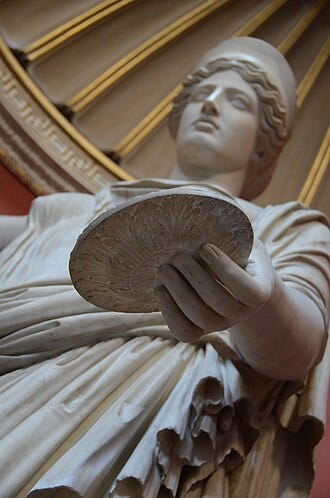
The translation of Hera into the Roman Juno involved a complex process of interpretatio romana, where the two deities were merged based on their shared patronage of marriage and the state. However, Juno retained distinct Italic characteristics that Hera lacked, such as Juno Lucina, the goddess of childbirth, and Juno Moneta, the protectress of the mint and a guardian of the state. Unlike Hera, who was in myths often in conflict with Zeus, Juno was more seamlessly integrated into the Capitoline Triad alongside Jupiter and Minerva, serving as a pillar of Roman civic identity. As Mary Beard explains, the Roman adoption of Greek mythic structures allowed for a literary identification between the two, yet the lived religion of the Romans continued to treat Juno as a more militarily and politically active figure than her Greek counterpart.8
In the fifteenth century, the Byzantine philosopher Georgios Gemistos Plethon reimagined Hera within his Nomoi, or Book of Laws, as part of his project to revive a refined form of Hellenic polytheism. Plethon did not view Hera through the lens of Homeric poetry, which he considered too humanized, but rather as a metaphysical principle. In Plethon’s hierarchy, Hera is the eldest daughter of Zeus and the primary “Idea” or Protoplast. She serves as the feminine principle of “Identity,” responsible for the stabilization and differentiation of forms within the intelligible world.9 For Plethon, Hera represents the “Great Mother” of the lesser gods, acting as a mediator between the absolute unity of Zeus and the multiplicity of the created universe. Her role is one of cosmic governance and the preservation of the essential nature of all beings.10
The most definitive evidence of the final phase of Hera’s ancient worship is found at her primary sanctuaries in Samos and Olympia. At the Heraion of Samos, archaeological excavations have identified that the Sacred Way, the primary ceremonial route leading to the sanctuary, was repaved with costly stone slabs as late as the third century CE, indicating continued imperial or civic investment in her cultic infrastructure. However, the formal cessation of activity is generally linked to the late fourth century. The Temple of Hera at Olympia, one of the oldest monumental structures in Greece, fell into disuse following the final Olympic Games in 393 CE, after which the site was gradually reclaimed by natural disasters, including a major earthquake in the early fourth century that had already structurally compromised the temple.11 In Athens and other urban centers, epigraphic evidence and the presence of votive pottery suggest that small-scale, private veneration likely persisted until the mid-fifth century, supported by Neoplatonic circles who viewed Hera as a vital cosmic principle, as discussed in the works of philosophers like Plutarch of Athens.12
In a modern context, the most recent evidence for the worship of Hera is found within the contemporary religion of Hellenism, or Hellenic Reconstructionism. This movement, which gained official legal recognition from the Greek state in the early twenty-first century, involves the active celebration of ancient festivals such as the Gamelion, the month of marriage dedicated to Hera.
_________________________
Bibliography and further reading
Beard, Mary, John North, and Simon Price. Religions of Rome: Volume 1, A History. Cambridge University Press, 1998.
Burkert, Walter. Greek Religion. Translated by John Raffan, Harvard University Press, 1985.
Connelly, Joan Breton. Portrait of a Priestess: Women and Ritual in Ancient Greece. Princeton University Press, 2007.
Homer, Iliad. Translated by Robert Fagles, Viking Penguin, 1990.
Pirenne-Delforge, Vinciane, and Gabriella Pironti. “The Hera of Zeus: Intimate Relations, Religious Gaze.” Kernos, vol. 28, 2015, pp. 153-171.
Saradi, Helen. “The Archaeology of Late Antique ‘Paganism’: The Case of Greece.” Late Antique Archaeology, vol. 7, no. 1, 2011, pp. 313-356.
Siniossoglou, Niketas. Radical Platonism in Byzantium: Illumination and Utopia in Gemistos Plethon. Cambridge University Press, 2011.
Hesiod, Theogony. Translated by M.L. West, Oxford University Press, 1988.
University of Warwick. “Temple of Hera, Olympia.” Department of Classics and Ancient History, 2017.
Woodhouse, C.M. George Gemistos Plethon: The Last of the Hellenes. Clarendon Press, 1986.
Homer, Iliad 1.568
Homer, Iliad 4.50
Hesiod, Theogony 355
Homeric Hymn to Pythian Apollo 3.310-315
Connelly 24
Pirenne-Delforge and Pironti 154
Burkert 131
Beard, North, and Price 14
Woodhouse 322
Siniossoglou 168
University of Warwick. “Temple of Hera, Olympia.”
Saradi 313-356