
Into the Labyrinth
History, Ritual, and Mysticism in the Myth of the Minotaur

Deep within the multicursal ruins of Knossos, where ancient stone still echoes with the seismic tremors of the southern Aegean, lies a narrative far more complex than a simple tale of a hero and a monster. For centuries, the story of the half-man, half-bull confined to an inescapable maze was read as a straightforward fable of Athenian triumph over Cretan tyranny. However, a deeper look reveals that this terrifying hybrid represents the intersection of physical reality and cosmic terror. By interweaving the tangible remnants of Aegean palatial hegemony with the deepest currents of ancient mysticism, modern scholarship demonstrates how Bronze Age archaeology and Orphic mystery cults transform an ancient monster into a map of the soul.
The myth of the Minotaur and the Labyrinth occupies a prominent place in the Western imagination, bridging the divide between classical Greek mythology and the archaeological realities of the Bronze Age Aegean. Recent scholarship in archaeology, religious studies, and psychoanalytic mythography has moved past early twentieth-century romanticism to reevaluate the historical veracity and esoteric meaning of this narrative. Rather than treating the myth as a static fable, contemporary experts analyze it as a layered cultural artifact. This artifact preserves memories of Minoan palatial hegemony, reflects complex architectural and spatial anxieties, and encodes profound mystery traditions centered on cosmic balance, human sacrifice, and the ecstatic cults of Dionysos and Ariadne.
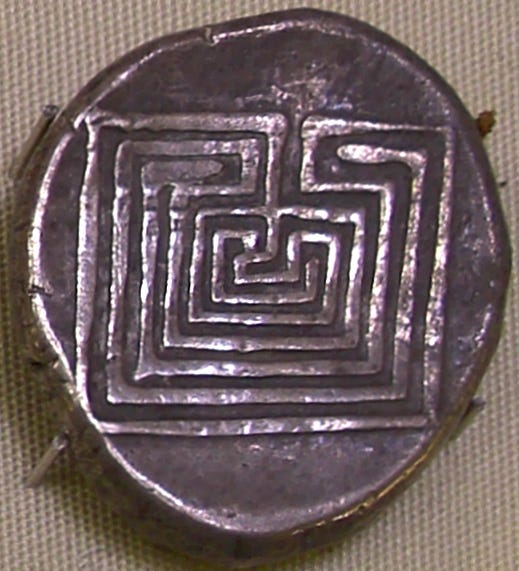
To understand the historical veracity of the myth, scholars look to the excavations begun by Sir Arthur Evans at Knossos in the early twentieth century. Evans famously utilized the local myths of Crete as an interpretive framework for the sprawling, multicursal structure he uncovered, asserting that the complex layout of the palace itself gave rise to the Greek concept of the Labyrinth (Shapland, 2023). Modern archaeological consensus, however, offers a more nuanced view. The structural complexity of the Palace of Knossos, characterized by dozens of interconnected rooms, blind corridors, and multi-storied lightwells, undoubtedly created a sense of profound spatial disorientation for visiting mainland Greeks (Harris, 2014, p. 134). This physical architecture, combined with the ubiquitous presence of bull iconography, formed the empirical substrate of the myth. This architectural reality is reinforced by the discovery of coins from the historical Greco-Roman city of Knossos that openly displayed the geometric emblem of the labyrinth, occasionally placing the Minotaur at the absolute center (Shapland, 2023). Thus, while a literal flesh-eating hybrid did not exist, the Labyrinth represents a stylized recollection of the administrative and ritual core of Minoan civilization.
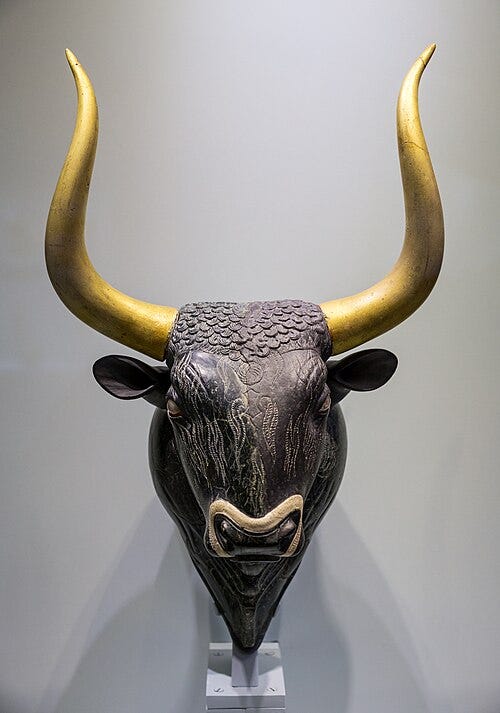
The core of the mythic drama rests upon the figure of the bull, a creature whose symbolic weight in Minoan culture cannot be overstated. Archaeo-mythological research demonstrates that the Minoans viewed the bull not merely as livestock, but as a physical representation of an earth deity or a cosmic force capable of destabilizing human architecture through earthquakes, a frequent hazard in the southern Aegean (Bermudes, n.d., paragraph 1). The mythic presentation of the white bull rising from the sea, sent by Poseidon to King Minos, underscores this chthonic power. Minos’s failure to sacrifice the animal destabilized the divine order, causing Poseidon to curse Queen Pasiphae with a consuming lust for the beast. The resulting offspring, Asterion the Minotaur, symbolizes the monstrous consequence of disrupting cosmic boundaries and human-divine reciprocity (Harris, 2014, p. 144). Furthermore, the physical reality of the bull in Minoan life is well-documented through artifactual evidence, such as the elaborate bull-leaping frescoes and the limestone horns of consecration that adorned the parapets of the palace (Bermudes, n.d., paragraph 14). These artifacts indicate that interacting with the bull was an intensely spiritual endeavor, designed to demonstrate human agility and ritual mastery over chaotic natural forces.
Closely tied to this bull symbolism is the harrowing motif of human sacrifice, represented in the myth by the Athenian tribute of seven young men and seven young women sent every nine years to be devoured by the Minotaur (Harris, 2014, p. 144). For decades, historians debated whether this element reflected actual Bronze Age practices or was merely Athenian propaganda designed to justify later political dominance over the Aegean (Corbelli, 2020, p. 740). However, recent archaeological discoveries on Crete, specifically at sites like Anemospilia and Knossos, have forced a reexamination of this problem. Excavations have revealed human skeletal remains bearing trauma consistent with intentional cut marks and sacrificial slaughter, suggesting that in times of extreme existential crisis, such as catastrophic earthquakes or foreign invasions, the Minoans may have resorted to human sacrifice to appease their chthonic deities (Cromarty, 2008, p. 112). In the mythic narrative, this terrifying ritual reality is transformed into a civic memory of subjugation, where the maze becomes an inescapable slaughterhouse, and the Minotaur embodies the insatiable appetite of an absolute, sacred authority.
Beyond the political and historical interpretations, esoteric and depth-psychological analyses view the Labyrinth as a map of human consciousness and initiation. Philosophers and mythologists emphasize the distinction between a multicursal maze, which contains dead ends and deceptions, and a classical, unicursal labyrinth, which features a single, winding path leading inevitably to the center (Harris, 2014, p. 134). Esoterically, entering the Labyrinth represents a catabastic journey—a descent into the underworld of the unconscious or the shadow self to confront the primal, bestial nature represented by the Minotaur (Knox, 2015, p. 45). The journey requires a total dismantling of ordinary spatial awareness and memory, forcing the seeker to navigate a territory where linear logic fails (Traweek, 2012, p. 94). The death of the Minotaur at the hands of Theseus signifies the victory of solar, ordering consciousness over chthonic chaos, but this victory is entirely dependent on the feminine principle, embodied by Ariadne and her indispensable thread.
Ariadne’s role extends far beyond that of a helpful secondary character in a heroic adventure. Epigraphic and religious scholarship identifies Ariadne as an ancient Cretan divinity in her own right, long before she was incorporated into the patriarchal Greek pantheon as a mortal princess. Her name, derived from the Cretan terms meaning extremely pure and extremely clear, points to her status as a goddess of light, weaving, and cosmic order (Corbelli, 2020, p. 735). In the esoteric tradition, Ariadne is the Lady of the Labyrinth, the sovereign of the sacred performance space where life, death, and rebirth are negotiated (Corbelli, 2020, p. 736). Her ball of thread is not merely a mechanical tool, but a profound mnemonic device and a symbol of the spiritual lineage or continuity of soul awareness that prevents the initiate from becoming permanently lost in the illusions of the material world (Traweek, 2012, p. 96). By anchoring the thread to the lintel of the labyrinthine gate, Ariadne bridges the manifest world with the hidden abyss, serving as the essential psychopomp who facilitates the successful return to the light.
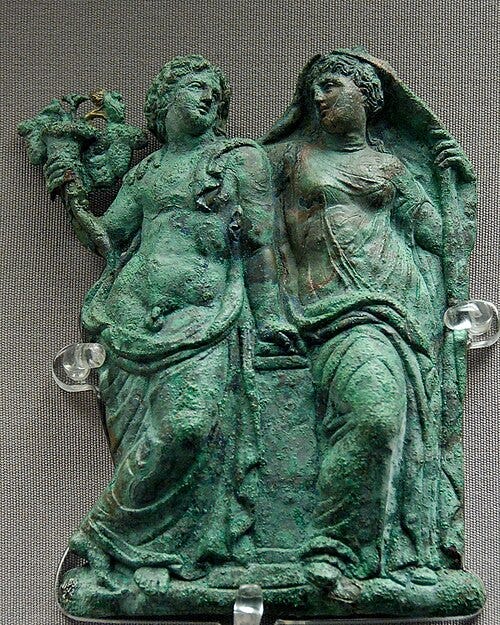
The ultimate destiny of Ariadne connects the myth of the Labyrinth directly to the mystery cults of Dionysos. According to classical traditions, after Theseus abandoned Ariadne on the island of Naxos, she was rescued by Dionysos, who claimed her as his divine consort and placed her bridal crown, the Corona Borealis, into the heavens. This union is central to the Neoplatonic and Orphic understandings of soul redemption. In late antique theology, Dionysos was revered as a savior figure and the intellect of the cosmos, mediating between the intelligible and sensible worlds (Hernández De La Fuente, 2018, p. 4). The Orphic mysteries often focused on the cycle of the soul, utilizing the myth of Dionysos to illustrate how divine consciousness is fragmented within the material realm and subsequently reassembled through sacred ecstasy and ritual purification (Hernández De La Fuente, 2018, p. 4). Ariadne’s transition from the terrifying depths of the Cretan Labyrinth to her mystical marriage with Dionysos represents the archetypal journey of the human soul. It signifies the evolution from a state of confinement and vulnerability to an enlightened state of sacred lucidity and divine union.
Contemporary expert opinion views the myth of the Minotaur and the Labyrinth as a sophisticated synthesis of history, ritual, and esoteric philosophy. The historical veracity of the narrative rests upon the architectural complexity of the Minoan palaces, the spiritual veneration of the cosmic bull, and the documented occurrence of chthonic human sacrifice. Simultaneously, the esoteric dimension transforms these historical elements into a universal allegory of initiation. Through the figures of the Minotaur, Theseus, Ariadne, and Dionysos, the myth articulates the eternal human struggle to navigate the confusing mazes of existence, confront the shadow within, and ultimately achieve spiritual liberation through the enduring threads of divine wisdom and ecstatic transformation.
Bibliography and further reading
Bermudes, P. (n.d.). The divine bull. Furman University Scholar Exchange, 1–15. Cited by: 1
Corbelli, L. (2020). Perversion and social innovation: The Minotaur, the labyrinth, Ariadne, Theseus, and Attica. Review of Psychology, 11(2), 731–745.
Cromarty, R. J. (2008). Burning bulls, broken bones: Sacrificial ritual in the context of palace period Minoan religion (Doctoral dissertation, Durham University).
Harris, P. A. (2014). Tracing the Cretan labyrinth: Mythology, archaeology, topology, phenomenology. Kronoscope, 14(2), 133–149. https://doi.org/10.1163/15685241-12341301
Hernández De La Fuente, D. A. (2018). Dionysus in the mirror of late antiquity: Religion, philosophy and politics. Complutense University of Madrid Faculty Documents, 1–22.
Knox, J. (2015). Inside the labyrinth: Assembly of ladies and Chartres Cathedral (Master’s thesis, Sam Houston State University).
Shapland, A. (2023). Knossos, myth and reality: The Ashmolean Museum’s exhibition Labyrinth. Oxford University Research Archive.
Traweek, A. (2012). Theseus loses his way: Viktor Pelevin’s Helmet of Horror and the old labyrinth for the new world. Dialogue: A Journal of Theology and Culture, 45(1), 89–104.