
Reading Omens
A Brief History of Græco-Roman Divination

The earliest mentions of omens in Greek and Roman writings trace back to their foundational epic poetry and traditions. The practice of divination and the concept of a divine sign (ση~μα - sēma or οiωνoν - oiōnon) are deeply embedded in the works of Homer, the earliest surviving Greek literature (c. 8th century BCE). Omens from the flight and calls of birds are central, particularly those involving powerful birds like eagles and vultures, which were believed to be messengers of the gods, especially Zeus. This is sometimes called Ornithomancy (divination by birds) and it is the earliest form of divination described in Homer.
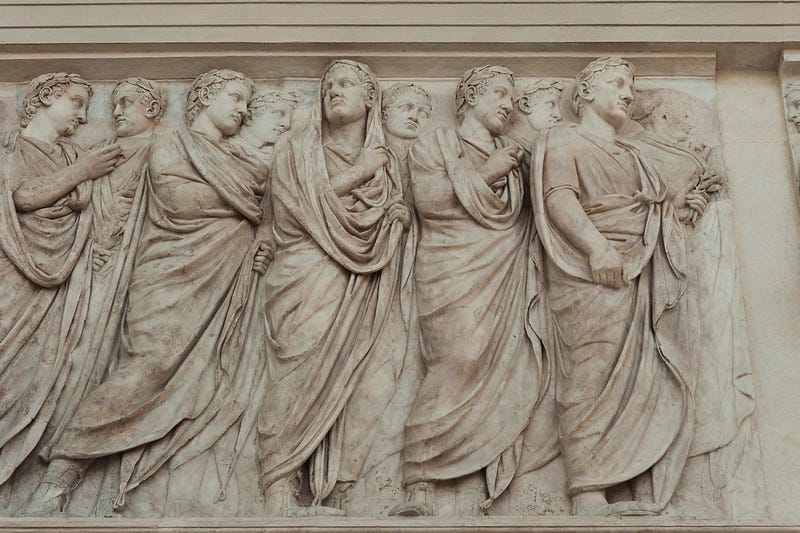
One of the most famous examples is the omen interpreted by the seer Calchas at Aulis, before the Achaeans set sail for Troy. A snake devours a sparrow and her eight young. Calchas interprets this analogically, predicting that the war will last nine years, and Troy will fall in the tenth.1
Thunder is another direct sign from Zeus.2 Hektor, for instance, interprets Zeus’ thunder as a sign of divine favor. The gods frequently intervene, sending omens or messages (aggelos) directly to mortals, often through animals or celestial phenomena. Even something as seemingly mundane as Telemachos’s sneeze in the Odyssey is interpreted by his mother Penelope as a favorable omen for the return of Odysseus.
Hesiod’s works, contemporary with Homer’s, also reflect an awareness of divine signs, although they focus more on the cosmic order and the relationship between gods and humans. Omens related to the observation of nature and the sky, which were vital for agricultural life, were a key aspect of his world.
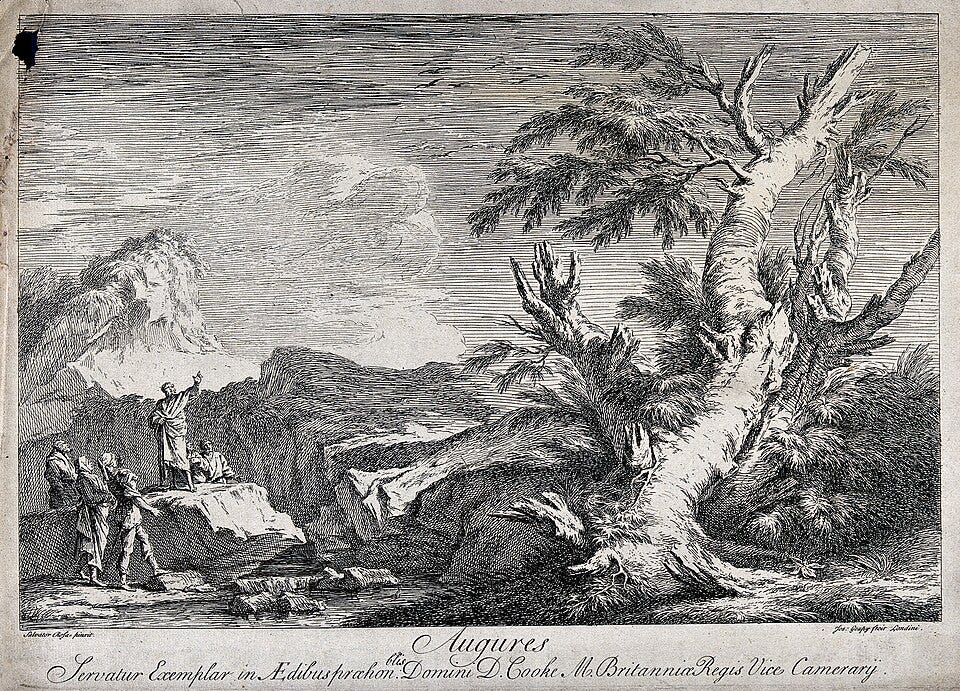
The earliest Roman tradition of omens, known as augury (divination by the observation of birds and celestial phenomena), predates their surviving literature. The pre-Roman Italic peoples of Italy certainly had their own means of divination and reading omens. One such example is The Piacenza Liver (Fegato di Piacenza). This bronze liver served as a teaching tool or reference manual for an Etruscan priest (haruspex). By comparing the actual liver of a sacrificed animal to this cosmic map, the haruspex could determine which deity or celestial region was responsible for a specific omen, thus interpreting the will of the gods. This visually demonstrates the technical, complex nature of Etruscan divination. The Piacenza Liver is estimated to date from the late 2nd century BCE, though the practice is much older.
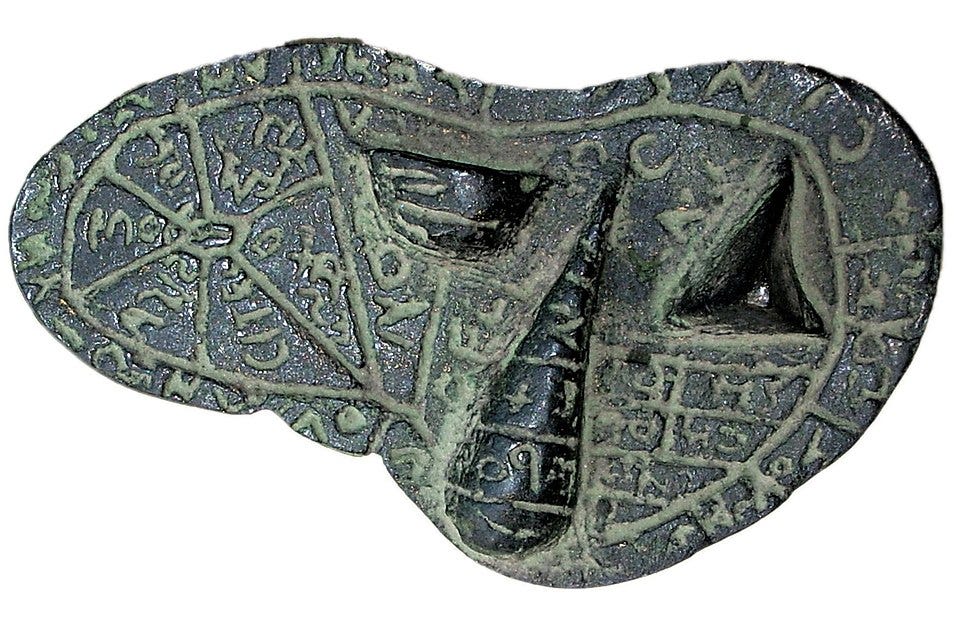
Although the original books of the Etrusca Disciplina are lost, the Roman author Cicero, an augur himself, in his work De Divinatione (44 BCE), references the contents of these Etruscan religious books, acknowledging their system for interpreting entrails (Haruspicini), lightning (Fulgurales), and rituals (Rituales). This is a primary source confirming the Roman knowledge of, and reliance on, the Etruscan divinatory tradition.
Unlike Rome, which preserved its religious literature through Latin authors like Cicero, or the Etruscans, who have thousands of short inscriptions and a few longer religious texts, like the Liber Linteus Zagrabiensis, the other Italic peoples left behind limited material for their spiritual practices. Despite the lack of detailed manuals, scholars infer that a common Italic tradition of divination was widespread, and the Roman system was not purely unique.
The foundation of Roman augury—observing bird signs (auspicium or augurium) and celestial phenomena like lightning (fulgura)—is considered to have a core that is essentially Italic in origin, even if the specific, elaborate procedural rules were influenced and codified by the Etruscans. It is highly probable that all Italic tribes practiced some form of this divination.
The Sabines are particularly noted in Roman tradition as a source of early Roman religion and practice. While specific Sabine divination rituals are not preserved in detail, figures like the legendary Sabine king Numa Pompilius were credited with establishing many early Roman religious rites, which would include forms of consulting the gods.
Animal sacrifice was a common religious act across the ancient world, including all Italic groups. Where there is animal sacrifice, extispicy (divination by examining the animal’s entrails, especially the liver, which the Romans called haruspicy after the Etruscans) is often implied. It is plausible that the Vestini, Marsi, and other groups bordering the Etruscans and Rome also employed this method, perhaps transmitted directly or indirectly from Etruria.
In recent times, some authors have attempted to reconstruct or create a divinatory system rooted in the Oscan language and spiritual concepts. An example found in modern literature is called “The Oscan Oracle,” which utilizes the letters of the Oscan alphabet as a form of divination (akin to runes or tarot). However, it is crucial to note that this is a modern, reconstructed system, and it is not a direct primary source or ancient manual recovered from the Oscans themselves. It represents a modern attempt to revive a lost spiritual lineage.
The most ancient tradition concerning omens in Roman culture is the contest between Romulus and Remus over the founding of Rome. According to the legend (recorded by later historians like Livy and Plutarch), they settled their dispute by observing the flight of birds (auspices): Remus first saw six vultures, but Romulus then saw twelve, which was interpreted as the decisive, favorable sign for Romulus to found the city on the Palatine Hill. This tale highlights that augury was seen as a foundational, divine institution in Rome, dating back to its very beginning.3
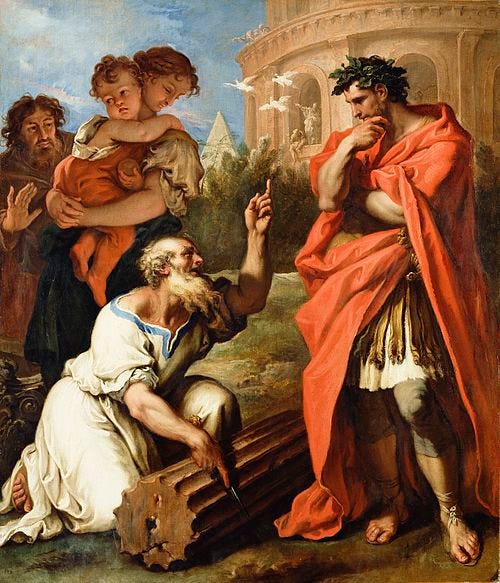
Actual surviving Roman literary texts are from a much later period than Homer. Early Roman historical accounts, such as those by Livy (Ab Urbe Condita, c. 1st century BCE/CE), are where these ancient traditions were formally written down. Livy frequently includes accounts of prodigies (extraordinary, often monstrous, omens that demanded public expiation) and omina (general signs) throughout his history, especially preceding great military or political events. For instance, Livy recounts the tale of the augur Attus Navius, a legendary figure from the Roman Kingdom, c. 600 BCE, who famously split a whetstone with a razor to prove his augural power to King Tarquinius Priscus.4
Sometimes, in both Greek and Roman history, the interpretation of omens went horribly wrong. When this occurred, the presumptuousness resulted in either ill-favor or outright anger, on the part of the gods. An especially heinous blunder of this kind can be seen in the omen received by the Greek army at Aulis. The seer Calchas interpreted an omen of a serpent devouring eight baby sparrows and their mother from a plane tree, and then turning to stone. Calchas interpreted this as a sign that the Trojan War would last ten years. While the ten-year war prediction came true, the larger issue was the subsequent difficulty in sailing, as the fleet was pinned down by ill winds. Calchas (or the tradition surrounding him) correctly identified the goddess Artemis as the source of the ill winds, but incorrectly stated the appeasement required was the sacrifice of commander Agamemnon’s daughter, Iphigenia, to atone for a past insult to the goddess. The sacrifice, whether it was completed or a deer was substituted, was seen as a grave, tragic act.5
The tragic misdirection of the omen’s consequence—that a human sacrifice was the only way to appease Artemis—did gain the fleet favorable winds. However, it also deeply angered Artemis– who was perhaps less interested in a human sacrifice than in a proper atonement–and it led to the unending, divine-level fury of Clytemnestra, Iphigenia’s mother, who would later murder Agamemnon upon his victorious return, thus setting off a new cycle of divine and human retribution.6
The Greeks were not alone in reading omens incorrectly from time to time. A clear historical example from Roman history shows the disastrous consequences of a magistrate deliberately ignoring a series of bad omens before a major military campaign. In 217 BC, before the Battle of Lake Trasimene against Hannibal, the consul Gaius Flaminius was warned by multiple negative omens. These included his horse throwing him just before a sacrifice, and the sacred chickens (used for augury) refusing to eat. In Roman military belief, if the sacred chickens refused the grain, the gods were displeased, and the expedition should be called off or postponed (tripudium was the positive omen of enthusiastic eating).7
Flaminius, known for his contempt for religious rituals, actively ignored or dismissed these divine warnings, effectively challenging the will of the gods. The battle proved to be one of the most catastrophic defeats in Roman history. Flaminius’s legions were ambushed and destroyed, and he himself was killed. This disaster was later interpreted by Roman historians, like Livy, as the direct punishment for Flaminius’s impiety and his reckless disregard for the clear signs sent by the gods. The correct interpretation of the omens was that they foretold disaster, and by ignoring them, Flaminius had effectively sealed his and his army’s fate, bringing the gods’ ira (anger) upon the Roman state.8
It is important to note that the use of omens across these cultures was not primarily about predicting the future in a fatalistic sense, but about determining the will of the gods regarding a proposed human action (political, military, or personal) to ensure the community’s success and maintain the peace of the gods (pax deorum).
In ancient primary sources, success from divination is rarely depicted as a specific prediction coming true. Instead, success is overwhelmingly framed as the positive outcome of obeying the divine will, while failure is the result of ignoring it. The proof of the divination’s accuracy is the subsequent military or political victory/disaster. The most common success story is a disaster that was averted because someone heeded a negative omen. This confirms the validity of the augury itself. The Roman author Cicero, in De Divinatione, mentions how the consul, Cato the Elder, stated he performed an act of augury (taking the auspices) before conducting any public business. The success here is implied: by performing the ritual correctly, Cato ensured his actions were sanctioned by the gods, leading to political order and stability.
Divination provided the foundation of both political and geographic authority, a successful outcome that justified the ritual. Livy and Plutarch both recount the contest between Romulus and Remus over who would found the city. Romulus’s sighting of twelve vultures (after Remus had seen six) was the divine confirmation (auspicium ratum) that he had the favor of Jupiter to proceed. The existence of Rome itself is the ultimate proof of this successful augury.9
As we can see in both Greek and Roman examples of omens, the most convincing proof of success is ritual correctness and the resulting political and/or military victory, which is taken as evidence of the gods’ approval, initially secured through accurate divination. The source rarely praises the augur; it praises the gods whose will was successfully revealed.
***
Bibliography and further reading
Aeschylus. Agamemnon. Edited and translated by Alan H. Sommerstein, Harvard UP, 2008.
Driediger-Murphy, Lindsay G. Roman Republican Augury: Freedom and Control. Oxford UP, 2019.
Euripides. Iphigenia in Aulis. Translated by W. S. Merwin and George E. Dimock, Oxford UP, 2004.
Homer. Iliad. Book 2, lines 303–330.
Livy. Ab Urbe Condita (The History of Rome) Translated by B. O. Foster, Loeb Classical Library, Harvard UP, 1929.
Plutarch. Life of Fabius Maximus. Chapter 3, section 2.
Plutarch. Life of Romulus. Chapter 9, sections 3–5.
Polybius. The Histories: Book III, Chapters 80-84. Translated by W. R. Paton, Loeb Classical Library, Harvard UP, 1922.
Simonetti, Elsa Giovanna, and Claire Hall, editors. Divination and Revelation in Later Antiquity. Cambridge UP, 2023.
Valerius Maximus. Memorable Doings and Sayings: Book I, Chapter 6, Section 6. Edited and translated by D. R. Shackleton Bailey, Loeb Classical Library, Harvard UP, 2000.
Iliad 2.308-330
Il. 8.170–171
Livy, Titus. Ab Urbe Condita. Book 1, Chapter 6, lines 4–8), and Plutarch. Life of Romulus. Chapter 9, sections 3–5.
Ibid. Livy, Book 1, Chapter 36, sections 2–6.
Il. Book 2, lines 303–330
See: Euripides. Iphigenia in Aulis. Translated by W. S. Merwin and George E. Dimock, Oxford UP, 2004, and Aeschylus. Agamemnon. Edited and translated by Alan H. Sommerstein, Harvard UP, 2008.)
Livy, Book 21, Chapter 63, sections 7–13, and Plutarch. Life of Fabius Maximus. Chapter 3, section 2
Livy, Book 22, Chapters 1-4. Translated by B. O. Foster, Loeb Classical Library, Harvard UP, 1929, and Polybius. The Histories: Book III, Chapters 80-84. Translated by W. R. Paton, Loeb Classical Library, Harvard UP, 1922, and Valerius Maximus. Memorable Doings and Sayings: Book I, Chapter 6, Section 6. Edited and translated by D. R. Shackleton Bailey, Loeb Classical Library, Harvard UP, 2000.
Livy, Book 1, Chapter 7.