
Spectral Symposia
Fireside Ghost Tales of Ancient Greece

One of my most beloved winter traditions is to enjoy M.R. James’ famous ghost stories, which he was known to read to his students on long December nights. It turns out, telling Yuletide ghost stories is quite a bit older than the old provost of King’s College and Eton.
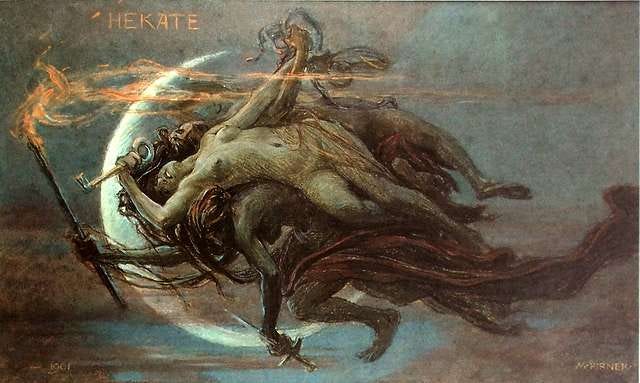
The tradition of sharing supernatural tales during the winter months finds deep roots in ancient Greek literature and folk belief, where the boundary between the living and the dead was perceived as particularly thin. The practice of telling supernatural stories often occurred during the evening symposium, where guests would share accounts of the uncanny as a form of intellectual and social entertainment. One of the most significant scholarly sources on this phenomenon explains that these narratives were not merely for thrills but served to reinforce the cultural boundaries between the world of the light and the world of the dark.1 Plato himself references the tradition of mothers and nurses telling frightening stories to children involving the spirits known as Mormo and Lamia, which were used as cautionary figures to ensure obedience. While Plato criticized these tales for instilling unnecessary fear in future citizens, his mentions confirm that ghost stories were a staple of domestic life from a very early period.2 As my regular readers might remember, this will not be my only disagreement with Plato.
Notwithstanding Plato’s admonishments, the intersection of the supernatural and the physical landscape was also a common theme in early storytelling for the Greeks. Pausanias records a tradition from the city of Temesa regarding a hero who was murdered and returned as a vengeful spirit known as the Ghost of Temesa. This spirit allegedly terrorized the inhabitants and demanded the annual sacrifice of a young maiden until an Olympic boxer named Euthymus challenged the ghost to combat and drove it into the sea.3 This account is categorized by modern scholars as a foundational legend that bridges the gap between historical memory and the folkloric belief in the dangerous power of the unvenerated dead.4 Such stories were frequently repeated during the winter months when agricultural work ceased and the long nights provided the appropriate atmosphere for discussing the influence of the underworld on the living.
One of the most famous early accounts of a haunting is provided by Pliny the Younger, who describes a spacious but deserted house in Athens. According to his account, a ghost resembling an old man with a long beard and rattling chains would appear at night, terrifying any who dared to inhabit the space until the philosopher Athenodorus investigated the site. Upon following the specter to a specific spot in the courtyard and marking it, Athenodorus directed the authorities to dig, where they discovered a skeleton entwined in chains.5 This narrative established many of the tropes common to the Western ghost story, including the restless spirit seeking a proper burial.
Phlegon of Tralles, a freedman of the Emperor Hadrian, preserved even older and more unsettling folk traditions in his Book of Marvels. One such tale involves a young woman named Philinnion who returns from the dead to visit a guest staying in her parents’ home. Unlike a traditional incorporeal ghost, Philinnion appears physically present, eating, drinking, and exchanging gifts with the young man until her parents discover her. Upon being confronted, she explains that her return was granted by the gods of the underworld for a specific purpose before she falls dead once again.6 Scholarly analysis suggests these accounts were often rooted in the concept of the aoroi, or those who died prematurely, who were believed to linger near the world of the living.7
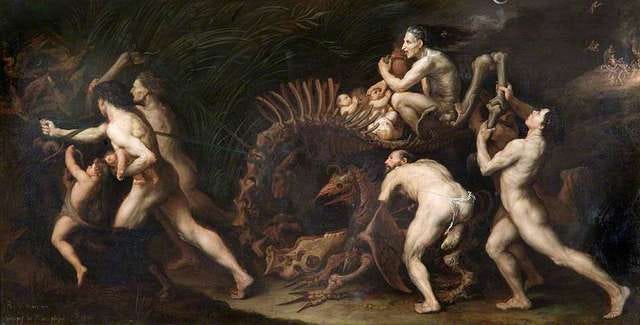
Another early supernatural element often discussed in ancient contexts involves the Hekateia, or the terrifying manifestations of the goddess Hekate. She was said to lead a spectral train of the restless dead during the dark of the moon, appearing at crossroads to those who offered sacrifices to appease her. Lucian of Samosata provides a more satirical but informative look at these beliefs, describing characters who claim to have seen various apparitions, including Hekate herself standing many cubits high with snakes for hair and feet.8 While Lucian intended to mock the gullibility of his peers, his descriptions accurately reflect the widespread contemporary belief in the physical reality of the supernatural.
To protect the household and community from the restless spirits of the dead, the Greeks observed specific rituals during festivals such as the Anthesteria, which occurred in late winter. This three-day festival was ostensibly dedicated to Dionysos, but its second day, the Choes, was considered a time of pollution when the souls of the deceased wandered the streets of the city. To guard against these spirits, inhabitants would smear their doorposts with pitch, a substance believed to ensnare or repel ghosts, and chew buckthorn leaves to physically and spiritually fortify themselves against malevolent influence.9 At the conclusion of the festival, the head of the household would march through the residence commanding the spirits to leave, uttering the ritual phrase, “depart, Keres, for the Anthesteria is over.”10
In addition to communal festivals, individuals utilized private protective measures to appease the dead and ensure they remained in the underworld. One common practice involved the offering of a deipnon, or a meal for Hekate, placed at three-way crossroads during the new moon. These offerings were intended to satisfy the hunger of the restless dead who followed the goddess, preventing them from entering nearby homes in search of sustenance. Archaeological evidence reveals that such offerings often included eggs, leeks, and fish, which were left behind without the donor looking back, as a backward glance was thought to invite a haunting.11 If a spirit was believed to be particularly persistent, families might employ a goēs, or a ritual specialist, to perform incantations and libations designed to guide the soul back to its proper place in Hades.12
If you are looking for a good pass-time on these long nights of winter, please indulge yourself in a good old creepy ghost story!
Bibliography and further reading
Burkert, Walter. Greek Religion. Translated by John Raffan, Harvard University Press, 1985.
Johnston, Sarah Iles. Restless Dead: Encounters Between the Living and the Dead in Ancient Greece. University of California Press, 1999.
Lucian. The Lover of Lies. Translated by A. M. Harmon, Loeb Classical Library 130, Harvard University Press, 1921.
Pausanias. Guide to Greece, Volume III: Elias II, Messenia. Translated by W. H. S. Jones, Loeb Classical Library 272, Harvard University Press, 1935.
Plato. Republic, Volume I: Books 1-5. Translated by Chris Emlyn-Jones and William Preddy, Loeb Classical Library 237, Harvard University Press, 2013.
Phlegon of Tralles. Book of Marvels. Translated by William Hansen, University of Exeter Press, 1996.
Pliny the Younger. Letters, Volume II: Books 7-10. Translated by Betty Radice, Loeb Classical Library 59, Harvard University Press, 1969.
Ogden, Daniel. Greek and Roman Necromancy. Princeton University Press, 2001.
Johnston 82
Plato 381e
Pausanias 6.6.7-11
Ogden 158
Pliny the Younger 7.27.5-11
Phlegon of Tralles 1.1
Ogden 146
Lucian 22-24
Ogden 215
Burkert 125
Johnston 48
Ogden 110