
The Sacred Commons
Restoring Human Dignity and Ecological Stewardship through the Classical Model

When we think of the applicability of lessons from the classics, very often we think of philosophy, mathematics, or literature. Upon closer inspection, however, it would seem there is an abundance of knowledge which has yet gone relatively untapped.
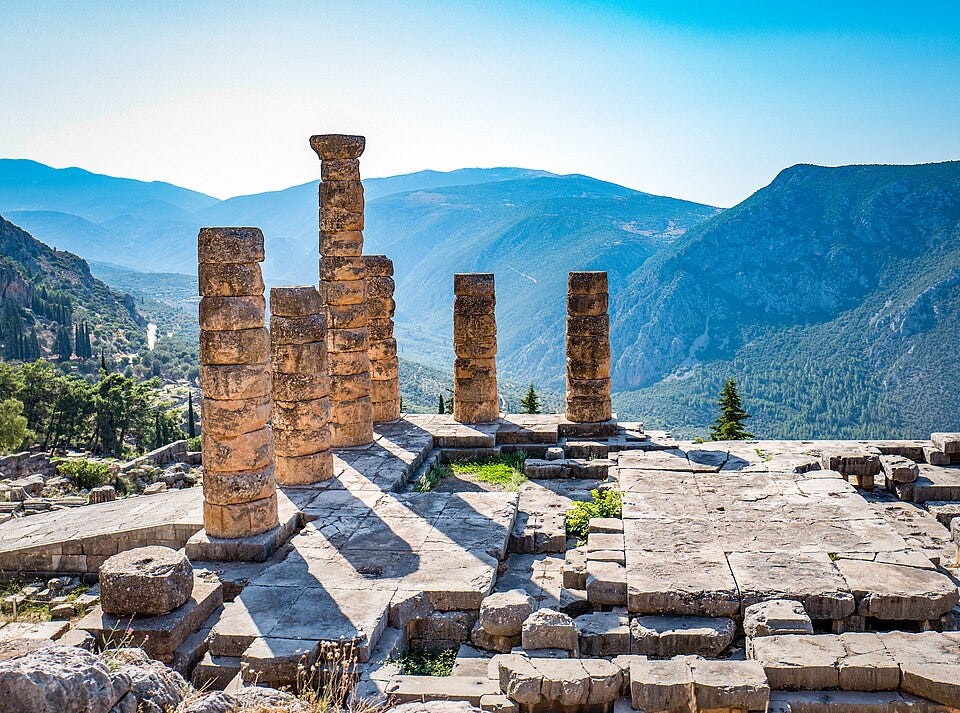
One example of this ancient knowledge is the management of common-pool resources in the ancient Mediterranean. These practices provide a sophisticated historical precedent for modern systems of decentralized governance. While contemporary economic discourse often oscillates between the poles of total privatization and state command, the classical world functioned through a dense web of overlapping jurisdictions, religious mandates, and local communal agreements. This arrangement did not arise from a lack of centralized power, but rather from a recognition that the dignity of the human person and the health of the local ecology were best preserved through local agency and mutual adjustment. By examining primary evidence regarding sacred groves, the management of water through the Attic demes, and the role of the Amphictyonic leagues, it becomes clear that the classical model of resource management was fundamentally multi-centered, viewing the landscape not as an extractable commodity, but as a shared sanctuary.
A primary example of this ecological management is found in the protection of the alsos, or sacred grove. These were not merely religious sites but were functional ecological preserves that prevented overgrazing and deforestation. In the Suppliant Women, Euripides describes the grove as a place where the community gathers under the protection of the divine, suggesting a boundary that humans may enter but not exploit for commercial gain.1 These spaces were governed by strict epigraphical laws. An inscription from the island of Cos, dating to the fourth century BCE, explicitly forbids the cutting of cypress trees within the sanctuary of Asclepius, carrying a fine of one thousand drachmas for any violation.2 Such laws demonstrate that environmental protection was integrated into the sacred law of the community, ensuring that the natural world remained uninterrupted by individual greed.
The management of water resources, particularly in the arid climate of Attica, further illustrates the efficiency of local governance. Rather than a singular water authority in Athens, the management of springs and wells was often the responsibility of the local deme. Aristotle, in the Constitution of the Athenians, notes the existence of elected officials known as the epistatai ton krenon, or overseers of the springs, who were tasked with maintaining the physical infrastructure and ensuring equitable distribution.3 However, the true governance happened at the level of the demarchos, who resolved disputes between neighbors. This reflects the principle that those closest to the resource are the best suited to manage it. The legal framework provided by the city served as a secondary layer of support for these local arrangements, ensuring that the dignity of the individual farmer was protected against the potential encroachment of wealthier neighbors.
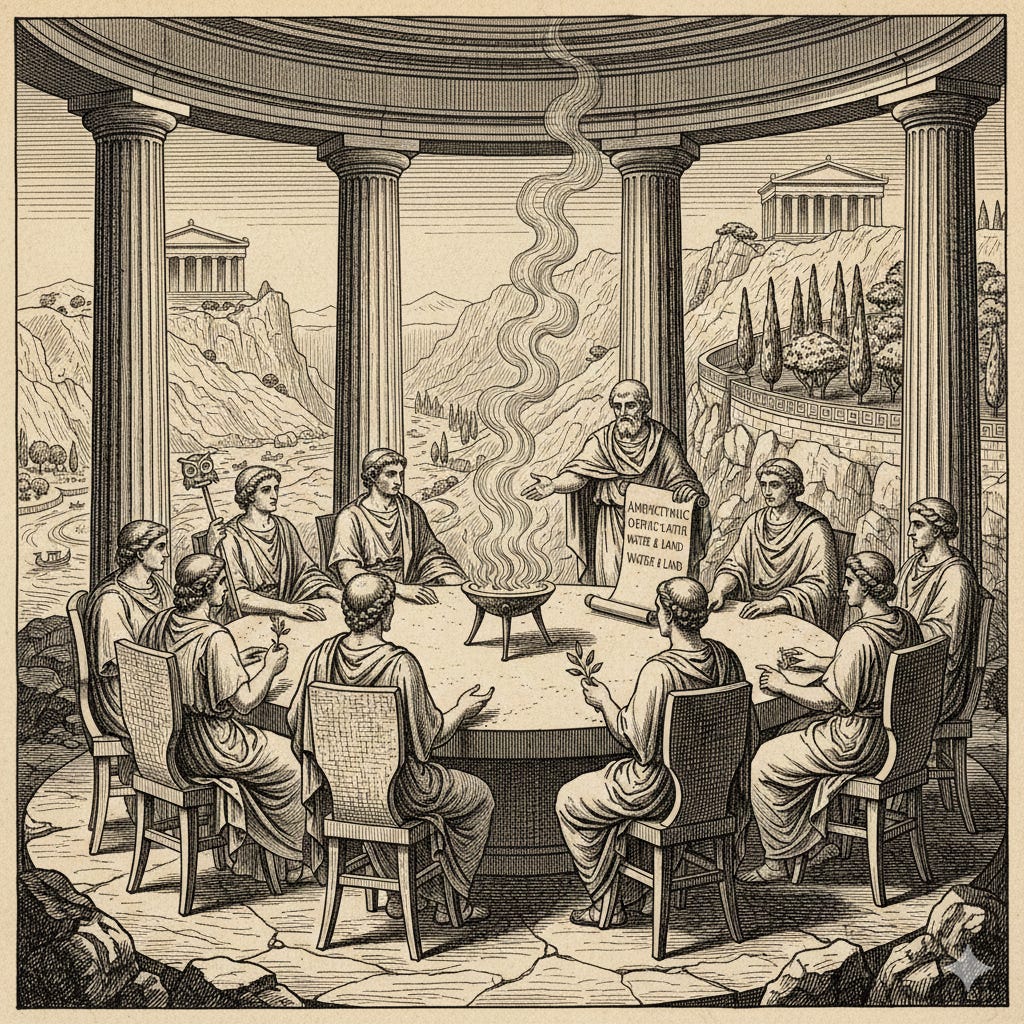
On a broader scale, the Delphic Amphictyony represents a model of inter-state cooperation that protected shared cultural and physical resources. This religious league, composed of twelve tribes, was not a state but a federation dedicated to the protection of the Temple of Apollo and the surrounding lands. The Amphictyonic oath, as recorded by Aeschines, famously included a pledge not to destroy any city of the league, nor to cut off its running water in either war or peace.4 This represents one of the earliest recorded international agreements to protect vital ecological infrastructure. The league acted as a higher-tier center of decision-making that could adjudicate between city-states, yet it left the internal governance of those states intact. This layering of authority—from the household to the deme, to the city, to the league—prevented the rise of a monocentric tyranny while providing a framework for the resolution of conflicts over shared resources.
Modern scholarship has begun to recognize these ancient structures as precursors to the “governing the commons” theories developed by Elinor Ostrom. In his study of Greek land tenure, scholar Lin Foxhall argues that the Greek landscape was a “mosaic of micro-environments” where different types of ownership and usage rights coexisted.5 A single piece of land might have a private owner for its grain harvest, but the community might hold the rights to graze livestock on the stubble after the harvest, while a nearby spring remained a sacred public resource. This non-dualistic approach to property—where “mine” and “ours” are not mutually exclusive—allowed for a higher degree of systemic resilience. It ensured that the ecology of the vineyard was maintained by various stakeholders, each with a vested interest in the long-term health of the soil and water.
The dignity of the human person in this system was tied directly to their role as a steward. In the Oeconomicus, Xenophon presents the management of the estate as a form of cultivation that improves both the land and the soul of the manager. He argues that the earth provides the most to those who serve her best.6 Here, the economic life is not separated from the moral or ecological life. When resources are managed through local, transparent, and multi-layered agreements, the individual is not a passive consumer but an active participant in the maintenance of the common wealth.
This classical perspective offers a profound solution to the modern crisis of alienation. By shifting our focus from centralized control to a network of common-pool management, we can restore the sense of the world as a sanctuary. The ancient Greeks did not need a singular, global bureaucracy to protect their groves; they needed a shared understanding of the sacred and a legal structure that empowered local communities to act as guardians of their own environment. This recovery of a more human and ecological way of being recognizes that the most efficient way to manage a complex system is to allow for multiple centers of vitality, all working within a shared ethical framework that prioritizes the continuity of life over the accumulation of wealth.
_____________________________
Bibliography and further reading
Aeschines. Speeches. Translated by Chris Carey, University of Texas Press, 2000.
Aristotle. The Athenian Constitution. Translated by P. J. Rhodes, Penguin Classics, 1984.
Dillon, Matthew. Pilgrims and Pilgrimage in Ancient Greece. Routledge, 1997.
Euripides. Suppliant Women. Translated by James Morwood, Oxford University Press, 2008.
Foxhall, Lin. Olive Cultivation in Ancient Greece: Seeking the Ancient Economy. Oxford University Press, 2007.
Ostrom, Elinor. Governing the Commons: The Evolution of Institutions for Collective Action. Cambridge University Press, 1990.
Xenophon. Oeconomicus: A Social and Historical Commentary. Translated by Sarah B. Pomeroy, Clarendon Press, 1994.
Euripides 29-35
Dillon 24
Aristotle 43.1
Aeschines 2.115
Foxhall 48
Xenophon 5.12