
The Swallowed Future
Esoteric Succession and the Containment of Time in Graeco-Roman Myth

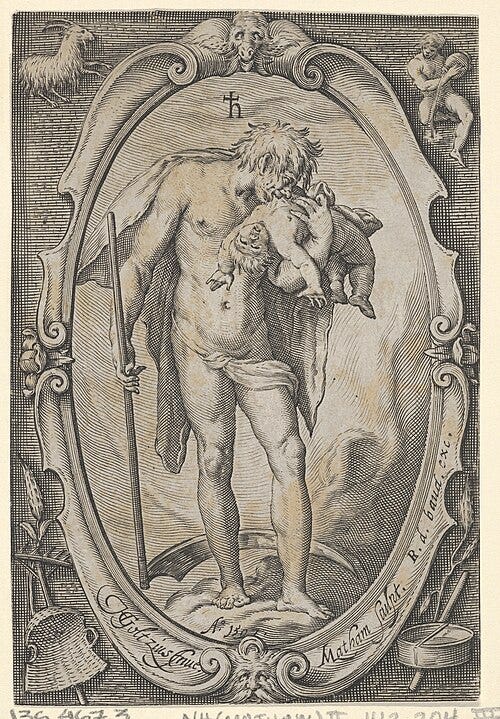
Before Zeus successfully instituted a divine personnel department, the early Greek cosmos was less of an organized pantheon and more of a deeply dysfunctional, multi-generational crime family with an alarming penchant for cannibalism–or at least that is what it seems on the surface. Long before mortals ever worried about getting eaten by wild beasts, the gods themselves were busy treating their own toddlers like an artisanal charcuterie board, driven by a paranoid obsession with retaining supreme power. This recurring cosmic nightmare of fathers swallowing the future—or keeping it trapped in the subterranean dark—was not merely a display of ancient horror, but a crude, necessary prelude to civilization. Beneath the shocking imagery of filial consumption lies a profound metaphysical evolution, tracing the agonizing labor pains of a universe struggling to break free from the suffocating tyranny of raw nature and time, eventually finding its permanent, rational equilibrium under the reign of Zeus.
The theme of filial consumption and succession within Hesiodic and Orphic cosmogonies presents a profound psychological, political, and metaphysical matrix for ancient Greek thought. Far from being mere primitive tales of horror, the successive depositions of Ouranos, Kronos, and the eventual stabilization under Zeus map the emergence of cosmic order from primordial chaos. By evaluating these myths through primary texts—predominantly Hesiod’s Theogony and relevant Orphic fragments—alongside scholarly commentary, we can discern how the transition from generational violence to harmonious governance reflects the classical understanding of the cosmos.
In the beginning, cosmic generation is marked by spatial compression and the suppression of potentiality. Ouranos, representing the starry sky, prevents his children from emerging from the womb of Gaia, the earth (Hesiod, Theogony 154-159). This initial conflict is fundamentally territorial; the father refuses to grant individual existence to his offspring, trapping reality in a state of unmanifested latency. The castration of Ouranos by Kronos, executed with a sickle of grey flint, serves as an act of cosmic separation. As Kirk, Raven, and Schofield observe, this act is mythologically necessary to create space between heaven and earth, allowing the cosmos to breathe and diversify. Esoterically, the sickle represents the cutting edge of time and division, breaking the undifferentiated unity of the primordial state to permit multiplicity.
However, the regime of Kronos replicates the tyranny of his father, shifting from external suppression to internal assimilation. Warned by Gaia and Ouranos that he is destined to be overcome by his own son, Kronos swallows his children—Hestia, Demeter, Hera, Hades, and Poseidon—as they leave the sacred womb (Hesiod, Theogony 453-467). This act illustrates the consuming nature of time, an association reinforced by the philosophical conflation of Kronos with Chronos though this idea has met with considerable criticism. By consuming his children, Kronos seeks to reverse the flow of generation, returning the manifested back into the unmanifested center of his own being. Scholars like Jean-Pierre Vernant highlight that Kronos represents a regressive sovereignty; his rule is a golden age of stagnation where nothing new can truly flourish because the future is constantly swallowed by the past.
The esoteric meaning of children deposing their fathers is rooted in the law of cosmic evolution and the limits of purely material or temporal power. Ouranos represents raw, unbridled generation without form; Kronos represents the rigid, consuming structure of time and material constraint. For the cosmos to achieve equilibrium, these one-sided principles must be overcome. The act of deposition is an ontological necessity; the younger deity represents a more articulated, differentiated stage of cosmic organization. When Zeus is saved by Rhea’s substitution of a swaddled stone—the Omphalos—Kronos swallows the symbol of the earth’s center, anchoring his own downfall. The subsequent Titanomachy is not merely a political coup but a cosmological battle between the old, chaotic forces of nature and the emerging principles of intelligence and justice.
Zeus terminates this destructive cycle of generational cannibalism through a radical transformation of the nature of sovereignty. Instead of suppressing his children externally or swallowing them post-birth, Zeus alters the mechanism when confronted with the threat of succession. Warned that his first wife, Metis (Wisdom), would bear a daughter equal in strength and a son who would become king of gods and men, Zeus deceives Metis and swallows her before she can give birth (Hesiod, Theogony 886-900).
This act is esoterically distinct from the cannibalism of Kronos. While Kronos swallowed his children to destroy them, Zeus absorbs the principle of Wisdom itself into his very core. By internalizing Metis, Zeus ensures that wisdom is permanently integrated into the divine administration. When Athena subsequently springs from his head, she represents intellect born directly from sovereign power, conditioned by divine law. Through this internal synthesis, Zeus neutralizes the threat of deposition; he cannot be overthrown because his rule is perfectly aligned with the ultimate rational ordering of reality.
Consequently, Zeus establishes an enduring cosmic order that stands in perfect harmony with the Fates (the Moirai). Hesiod notes that Zeus weds Themis (Divine Law), who bears him the Horai (Order, Justice, and Peace) and the Moirai—Clotho, Lachesis, and Atropos—who give mortal men both good and evil (Hesiod, Theogony 901-906). This marital alliance signifies that the rule of Zeus is not based on arbitrary tyranny or brute force, as was the case with Ouranos and Kronos, but on cosmic law and justice.
In classical scholarship, particularly the analyses of Hugh Lloyd-Jones, the relationship between Zeus and the Fates evolves from one of potential tension to complete alignment. Zeus does not master the Fates through violence; rather, his will becomes the execution of destiny. The Fates represent the unalterable boundaries of cosmic order, and Zeus acts as the supreme guarantor of those boundaries. Under his reign, the cosmos moves away from cyclic, generational warfare and stabilizes into a permanent hierarchy where every entity, divine and mortal, has its assigned portion (moira). The cosmological journey from the suffocating embrace of Ouranos to the wisdom-infused, fate-aligned court of Zeus mirrors the triumph of reason, justice, and sustainable order over the blind impulses of destruction and time.
Bibliography and further reading
Hesiod. Theogony. Translated by Glenn W. Most. Loeb Classical Library. Cambridge: Harvard University Press, 2018.
Kirk, Geoffrey S., John E. Raven, and Malcolm Schofield. The Presocratic Philosophers. Cambridge: Cambridge University Press, 1983.
Lloyd-Jones, Hugh. The Justice of Zeus. Berkeley: University of California Press, 1971.
Vernant, Jean-Pierre. Myth and Thought among the Greeks. London: Routledge and Kegan Paul, 1983.