

A Common Altar
Roman Antiquity, Hellenic Metaphysics, and the Development of Christian Sacramentalism

To the modern casual observer, the clouds of sweet-smelling frankincense, the meticulously starched vestments, and the rhythmic, rigid choreography of a solemn Catholic or Orthodox liturgy appear completely, and exclusively, Christian. Yet, if an ancient Roman magistrate from the late Republic were pulled across time and dropped directly into a High Mass at Saint Peter’s Basilica or a Divine Liturgy in Constantinople, he would not feel entirely out of place. He would likely bypass the theological nuances of the homily, ignore the strange, singular Galilean focus of the prayers, and confidently evaluate the ritual performance based on its pietas—the exact, legalistic adherence to ritual purity and ancestral custom. He might even nod approvingly at the lifting of the chalice, recognizing it instantly as an excellent, if slightly bloodless, libatio. Christian sacramentalism did not emerge into the Mediterranean world as a completely unprecedented novelty dropped cleanly from the heavens. Instead, it was meticulously forged inside an ancient furnace lined with the brickwork of the Roman cultus deorum and insulated by the lofty, structural mechanics of Greek philosophy.
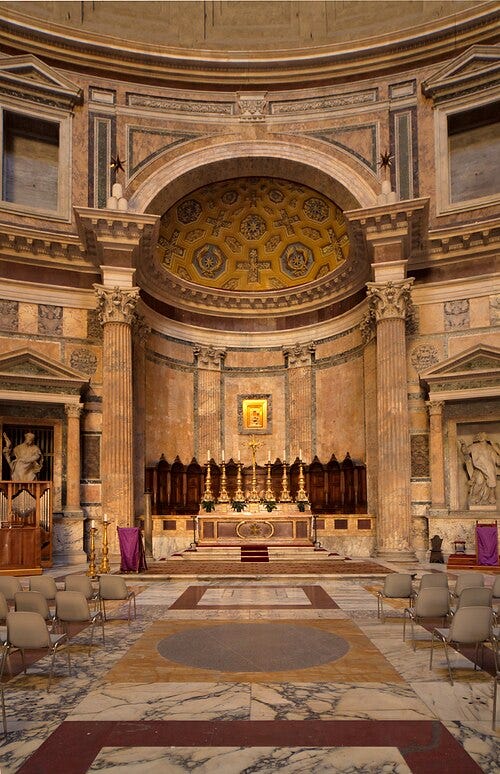
To understand how a small, eschatological Jewish sect transformed itself into a highly structured, sacramentally dense, global institutional empire, one must first confront the absolute legal and physical reality of the Roman civic religion. The Roman relationship with the divine was fundamentally contractual, governed by the celebrated legal maxim do ut des—I give so that you might give. Cicero notes that true religion is defined by the proper performance of ritual duties toward the gods, which ensures the pax deorum, the delicate peace between heaven and earth (De Natura Deorum, I.6). In this civic marketplace, intent was entirely secondary to execution. If a priest stumbled over a single syllable of a prayer while offering a heifer to Jupiter, or if a sacred chicken pecked the wrong grain, the entire multi-day ceremony was legally void and had to be restarted from the absolute beginning, a bureaucratic nightmare known as an instauratio (Livy, Ab Urbe Condita, II.36). This precise Roman anxiety over ritual mechanics directly shaped the developing Christian doctrine of ex opere operato—the theological principle that a sacrament operates effectively by virtue of the ritual action being correctly performed, rather than the moral purity of the officiating minister. It should be mentioned that this principle was rejected by the Donatists of North Africa. Named after its leader, Bishop Donatus Magnus, the movement emerged in the wake of the Diocletian persecutions (around 303 CE). Despite facing imperial suppression, the movement managed to survive for several centuries in North Africa before eventually fading into obscurity following the Arab conquests of the region in the 7th and 8th centuries. I mention them purely out of impishness, given my own surname. Mea culpa…
Where were we? Ah yes, this structural transmission becomes vividly apparent when examining the basic Catholic liturgical architecture, which borrowed heavily from the functional hierarchy of the polytheistic state. The early Christians did not look to the ruined Jewish Temple or the hidden domestic dining room for their permanent institutional style; they looked straight at the Roman civic basilica, the massive hall of imperial administration and judicial authority. The very title of the supreme Catholic pontiff, Pontifex Maximus, was lifted wholesale from the chief priest of the Roman state college, a position that Augustus Caesar had conveniently folded into the office of Emperor to keep the cosmic machinery under tight imperial control (Res Gestae Divi Augusti, 10). The Roman altar, or ara, was a site of structural, civic orientation, a geographic and cosmic point where the human and divine contracts were physically signed in blood and smoke. When Christianity emerged from the catacombs, it simply kept the architecture, kept the legal precision, and changed the name of the cosmic Landlord.
Yet, while Rome provided the legal scaffolding, the architectural bones, and the bureaucratic precision, the intellectual muscle and spiritual interiority of Christian sacramentalism were heavily imported from the Greek world, specifically through the profound historical influence of Pythagoreanism and Platonism. For the early Church Fathers, particularly those writing in Alexandria, Greek philosophy was not an enemy to be conquered, but a providential schoolmaster preparing the polytheistic mind for the Gospel. Middle Platonists and Neoplatonists (if we insist those terms are useful) had long argued that the material world was not a meaningless pile of debris, but an intentionally crafted, sensible reflection of a much higher, intelligible reality. Plato’s famous cosmological treatise, the Timaeus, asserted that the visible universe was generated as a living copy of the eternal Forms, bound together by an underlying mathematical harmony (Timaeus, 30c-31a). The Pythagoreans went even further, treating material numbers, geometric proportions, harmonics and physical elements as sacred symbols that participated directly in the divine Monad.
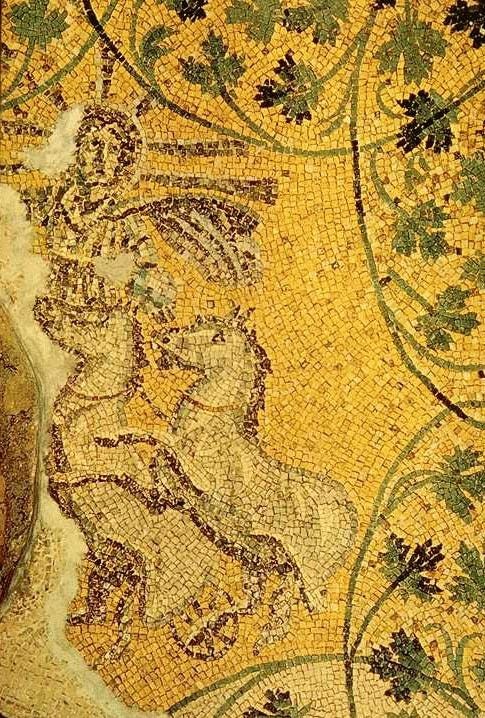
This philosophical outlook provided the perfect intellectual foundation for a sophisticated sacramental theology. If the material world was already structured as a vast, symbolic ladder descending from the Divine, then physical elements like water, wheat, olive oil, and wine could easily be viewed as natural vehicles capable of carrying supernatural grace. Saint Justin Martyr explicitly utilized Platonist philosophy to explain how physical materials could be transformed in Christian liturgy, arguing that just as the divine Word took on true material flesh, so too the bread and wine become the actual body and blood through the cosmic power of the eucharistic prayer (First Apology, 66). This is the ancient root of the sacramental principle: the physical world is inherently capable of participating in, and communicating, the divine essence. Without Plato’s cosmic ladder, the Christian sacraments would have remained mere empty, historical stage-props; with it, they became literal, glowing portals into the divine nature. This theological and sacramental history is at least partly to underscore that a literal reading of canonical texts, i.e., the Bible, was as insufficient a theological approach in Late Antiquity as it was when Martin Luther declared his Sola scriptura thesis (Scripture alone as the source of the Christian religion) during the Leipzig Disputation in July 1519. For starters, in Late Antiquity, there was no canonical Bible, but I digress yet again!
The deepest, most visceral convergence between the old Roman world and the new Christian order occurs at the sacrificial altar, particularly regarding the absolute, non-negotiable cultural necessity of blood sacrifice. In the ancient Mediterranean, a religion without blood was simply not a religion at all; it was merely a philosophy club. To approach the gods required an exchange of life, and since the life of a creature was understood to reside in its warm blood, the spilling of that blood on the stone altar was the ultimate act of cosmic reconciliation and purification. The Roman suovetaurilia—the grand, simultaneous slaughter of a pig, a sheep, and a bull—was designed to thoroughly cleanse the civic body and appease the gods through an overwhelming, sensory display of visceral death and burning fat (Cato, De Agri Cultura, 141). It was a messy, loud, and thoroughly bloody business. In an odd twist of historical irony, the polytheistic intellectual Celsus actually mocked the early Christians for their lack of visible altars and temples, assuming that because they did not slaughter sheep in public squares, they were essentially dangerous atheists who lacked a true connection to the cosmic order (Origen, Contra Celsum, VIII.17).
To survive and thrive in this intensely sacrificial atmosphere, Christianity could not simply abandon the concept of sacrifice; it had to radically internalize and transfigure it. The author of the Epistle to the Hebrews famously wrestled with this exact problem, explicitly utilizing Alexandrian Platonic categories to argue that while the old blood sacrifices of bulls and goats were merely earthly shadows, Christ had entered the true, heavenly sanctuary as the perfect, unblemished victim, offering his own blood once and for all (Hebrews 9:11-14). This theological maneuver transformed the Christian Eucharist from a simple, friendly memorial supper into a profound, terrifyingly real sacrificial act. The Eucharist became the re-presentation of that singular, definitive cosmic slaughter.
Because the Eucharist was understood as a genuine sacrifice, the Church required a specialized, distinct class of individuals to offer it. They needed priests precisely because they had retained a sacrifice. In the ancient mind, a priest was not a pastoral counselor, a social worker, or an entertaining public speaker; a priest was, first and foremost, a ritual butcher authorized to handle sacred blood. The Christian adoption of the Latin term sacerdos and the Greek hiereus directly signaled this profound functional continuity with the polytheistic past. Saint Ignatius of Antioch, writing at the dawn of the second century, stressed that the altar is inextricably linked to the bishop and his presbyters, and that apart from this rigid hierarchical structure, no legitimate sacrifice could occur (Letter to the Smyrnaeans, 8). The priest became the indispensable, sacred engineer who operated the cosmic machinery, ensuring that the divine life-force continued to flow safely into the community without causing a catastrophic spiritual short-circuit.
Thus, the majestic liturgy of the historical Church reveals itself not as an abrupt historical rupture, but as a brilliant, highly sophisticated synthesis of the ancient Mediterranean world. It successfully married the structural, legalistic, and architectural genius of Rome with the deep, soaring metaphysical cosmology of the Hellenistic Mediterranean, wrapping both around the core of the Christian mystery. When modern priests stand at the altar, surrounded by candles, facing the east, and murmuring ancient formulas, they are carrying forward an unbroken, millennia-old human tradition of navigating the sacred. No matter what one might think of the modern priesthood, there is no denying that it is a living monument to an era when law, philosophy, and blood converged to bridge the gap between the human polis and the eternal cosmos.
Bibliography
Augustus Caesar. Res Gestae Divi Augusti. Translated by Frederick W. Shipley. Loeb Classical Library. Cambridge: Harvard University Press, 1924.
Cato the Elder. De Agri Cultura. Translated by W. D. Hooper, revised by Harrison Boyd Ash. Loeb Classical Library. Cambridge: Harvard University Press, 1934.
Cicero, Marcus Tullius. De Natura Deorum. Translated by H. Rackham. Loeb Classical Library. Cambridge: Harvard University Press, 1933.
Ignatius of Antioch. “Letter to the Smyrnaeans.” In The Apostolic Fathers, translated by Bart D. Ehrman. Loeb Classical Library. Cambridge: Harvard University Press, 2003.
Justin Martyr. “First Apology.” In Ante-Nicene Fathers, Vol. 1, edited by Alexander Roberts and James Donaldson. Buffalo: Christian Literature Company, 1885.
Livy. History of Rome (Ab Urbe Condita), Books I–II. Translated by B. O. Foster. Loeb Classical Library. Cambridge: Harvard University Press, 1919.
Origen. Contra Celsum. Translated by Henry Chadwick. Cambridge: Cambridge University Press, 1953.
Plato. Timaeus. In Plato: Vol. IX, translated by W. R. M. Lamb. Loeb Classical Library. Cambridge: Harvard University Press, 1929.
A richly wovenl comparison of time and cultures. It was good to see the high altar of the Pantheon! I shall never forget how thrilled my husband, student of Yale School of Art and Architecture, was too see this wonderfully preserved ancient edifice.